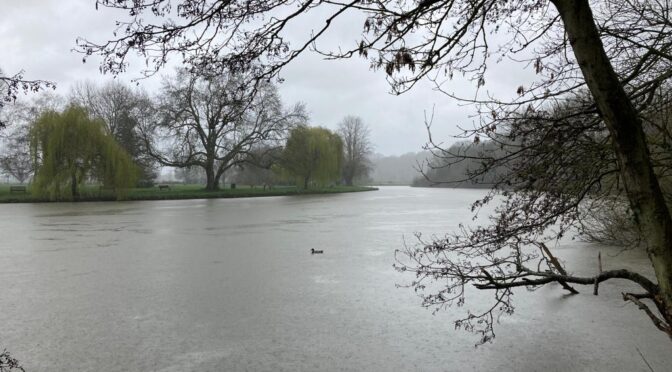
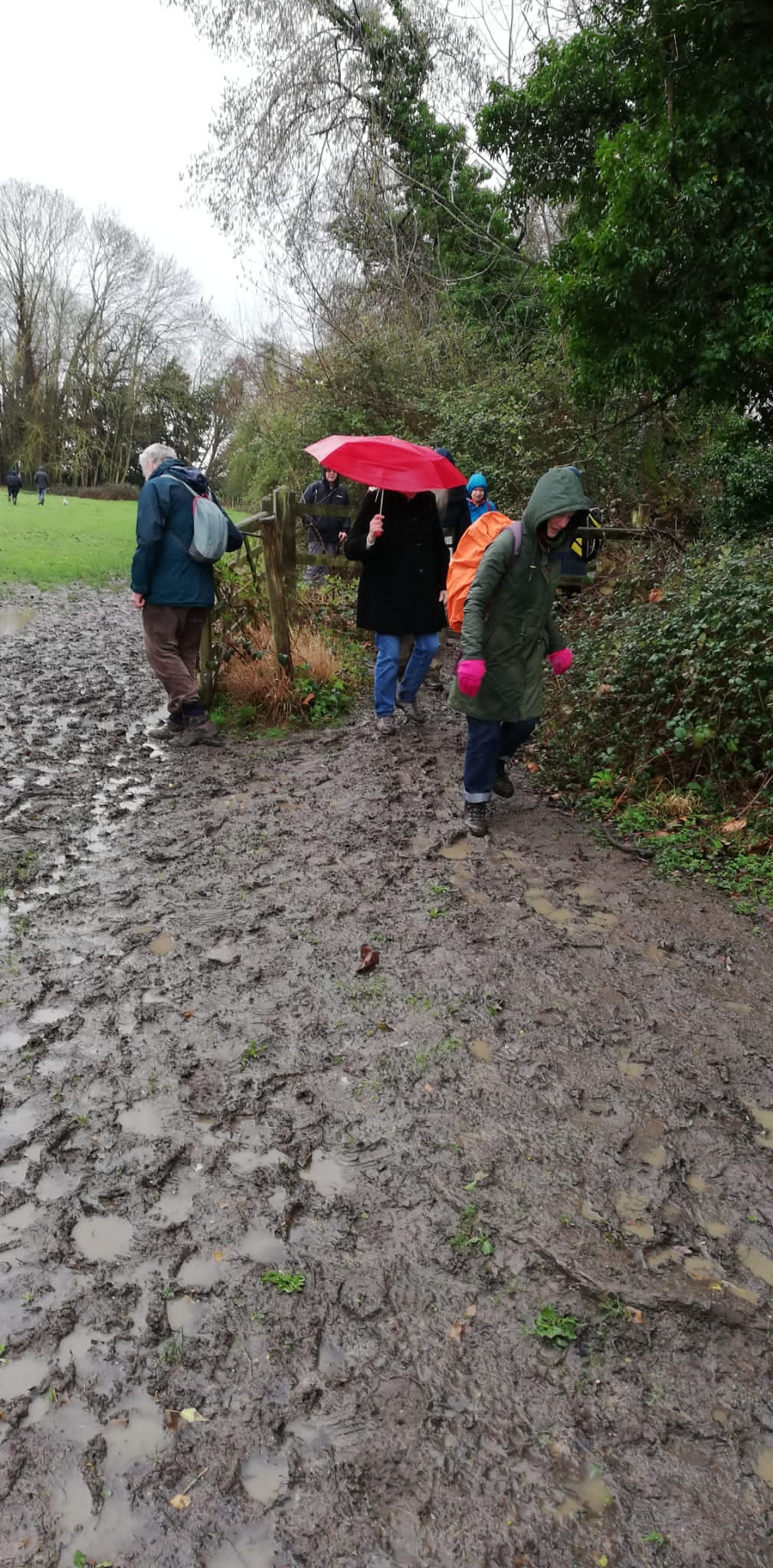
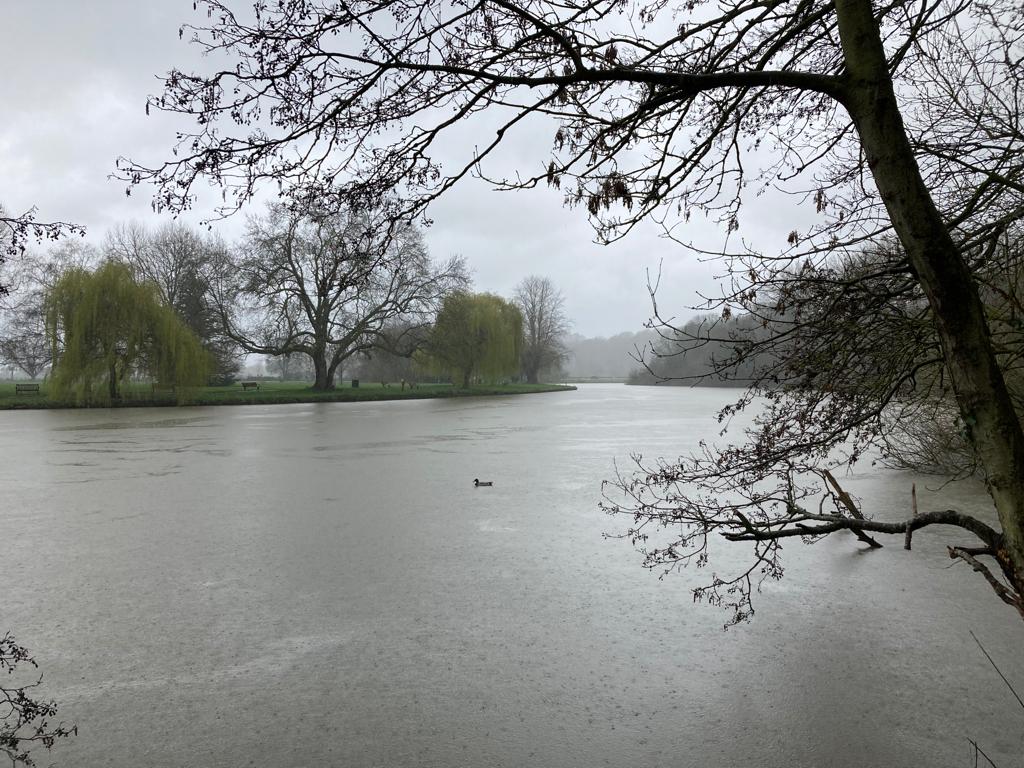
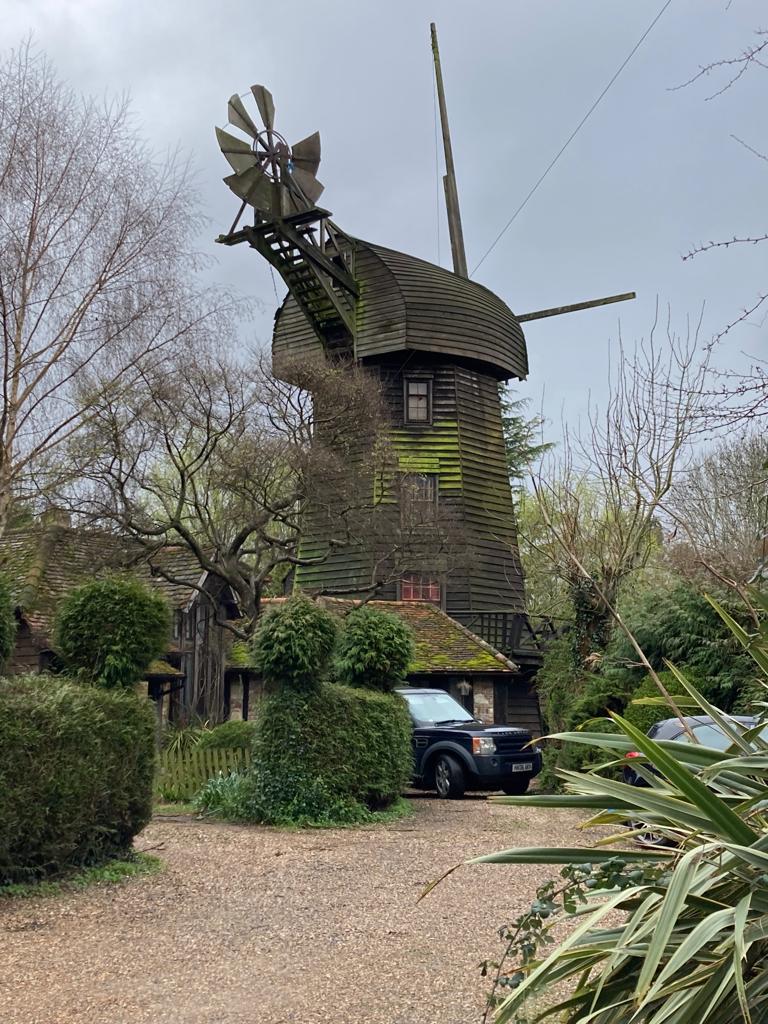
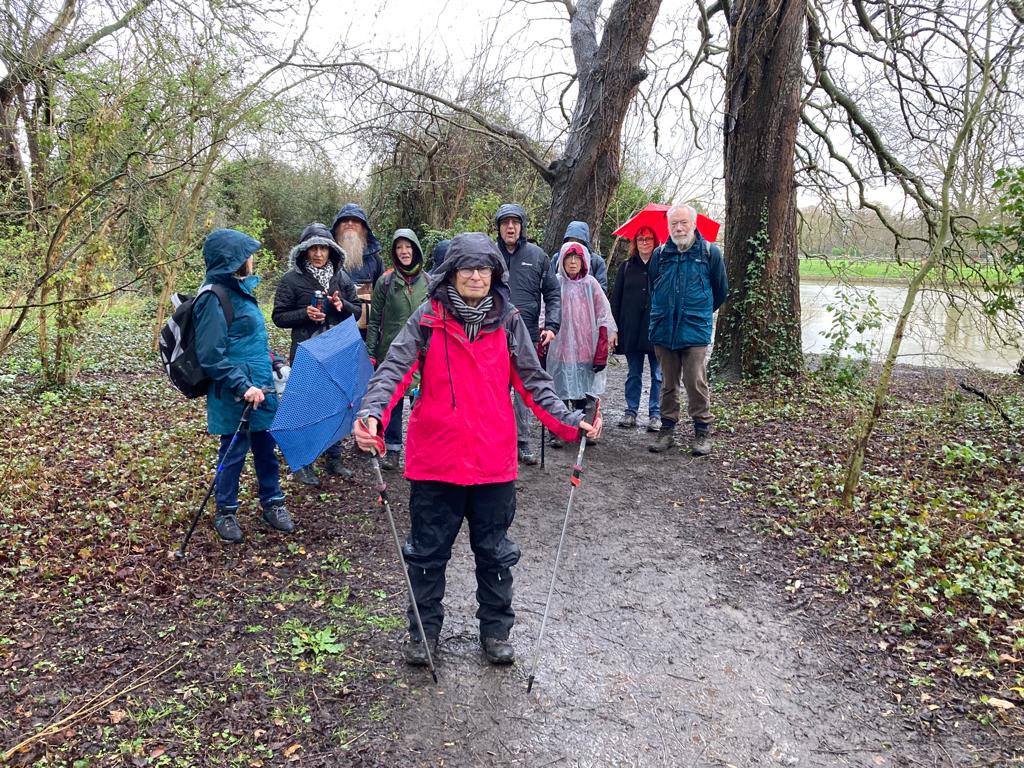
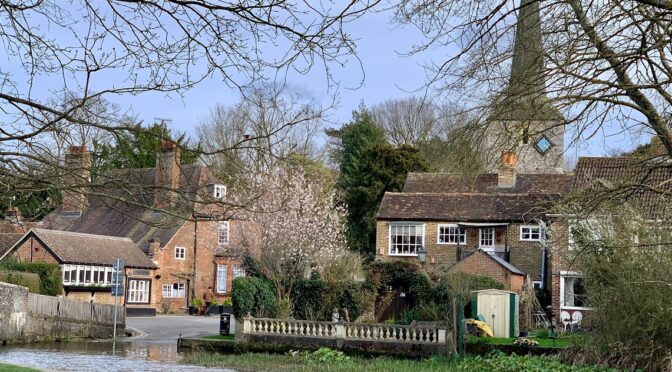
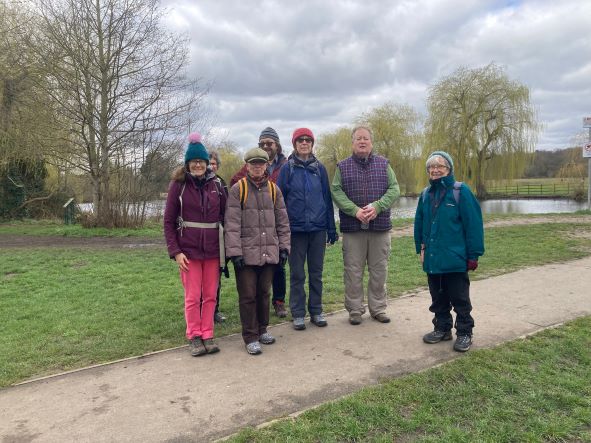
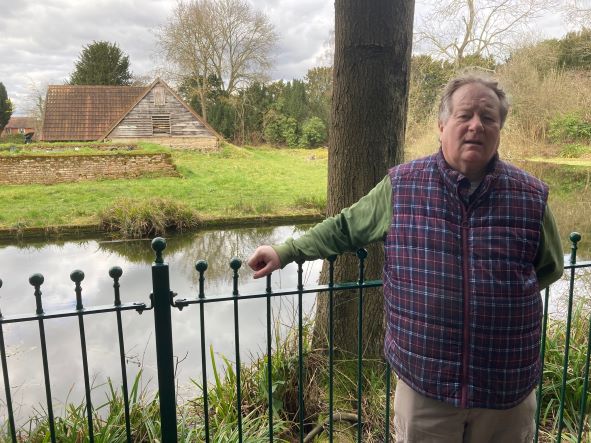
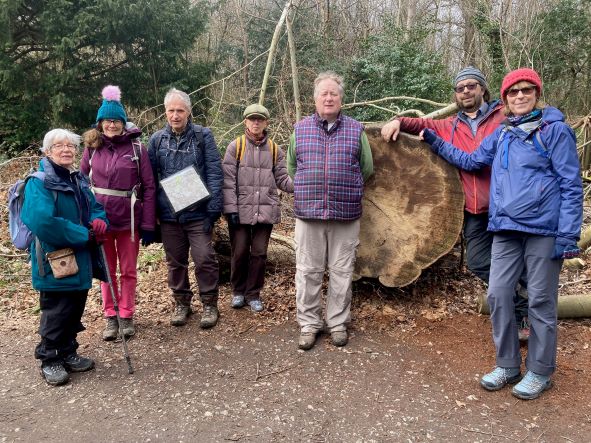
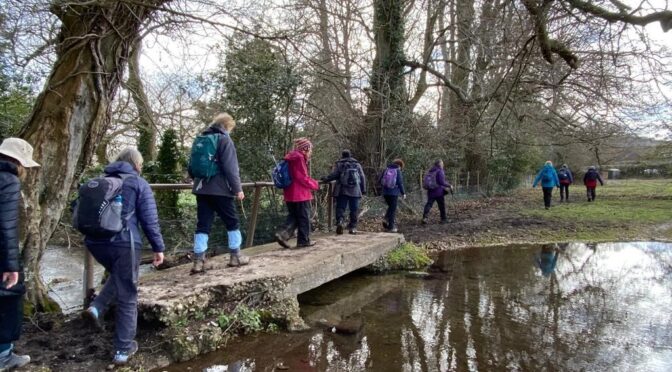
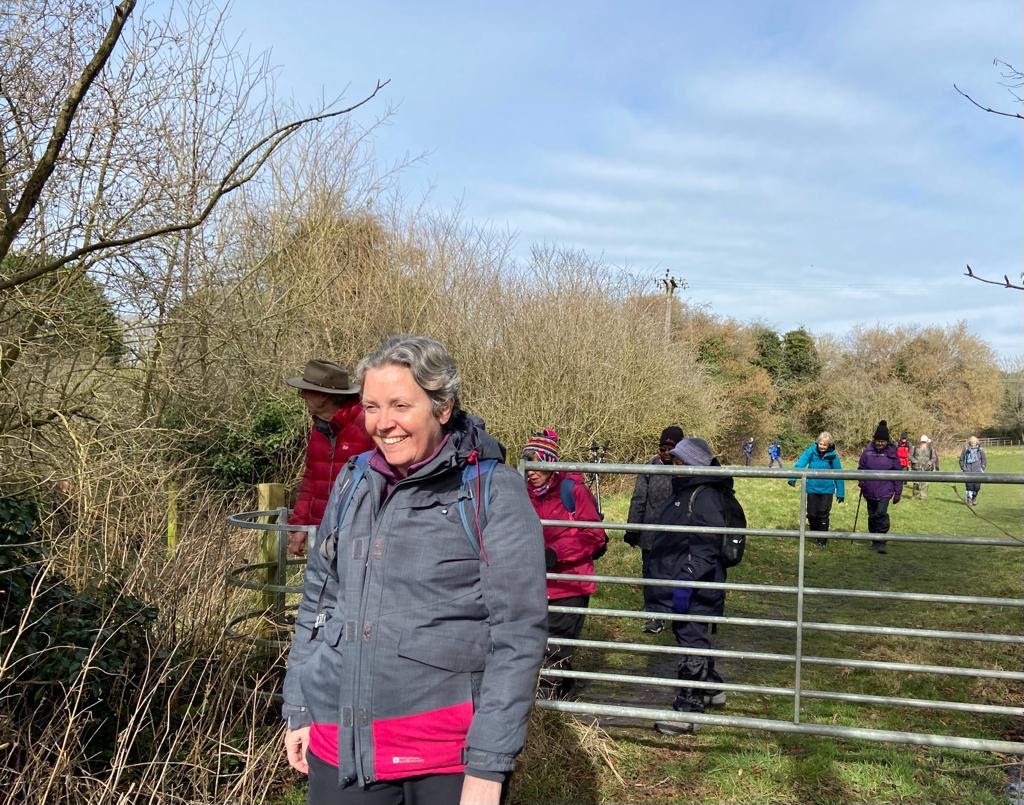
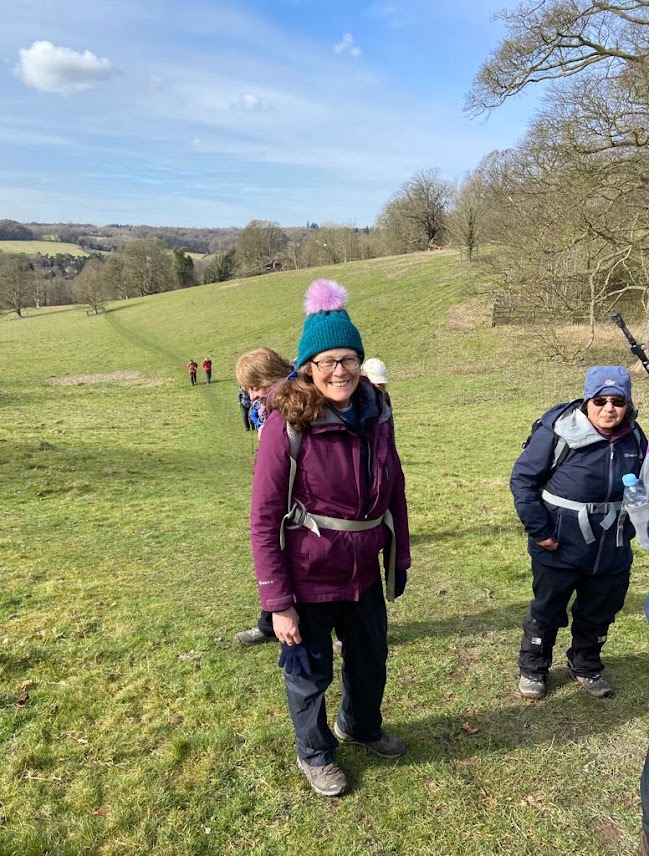
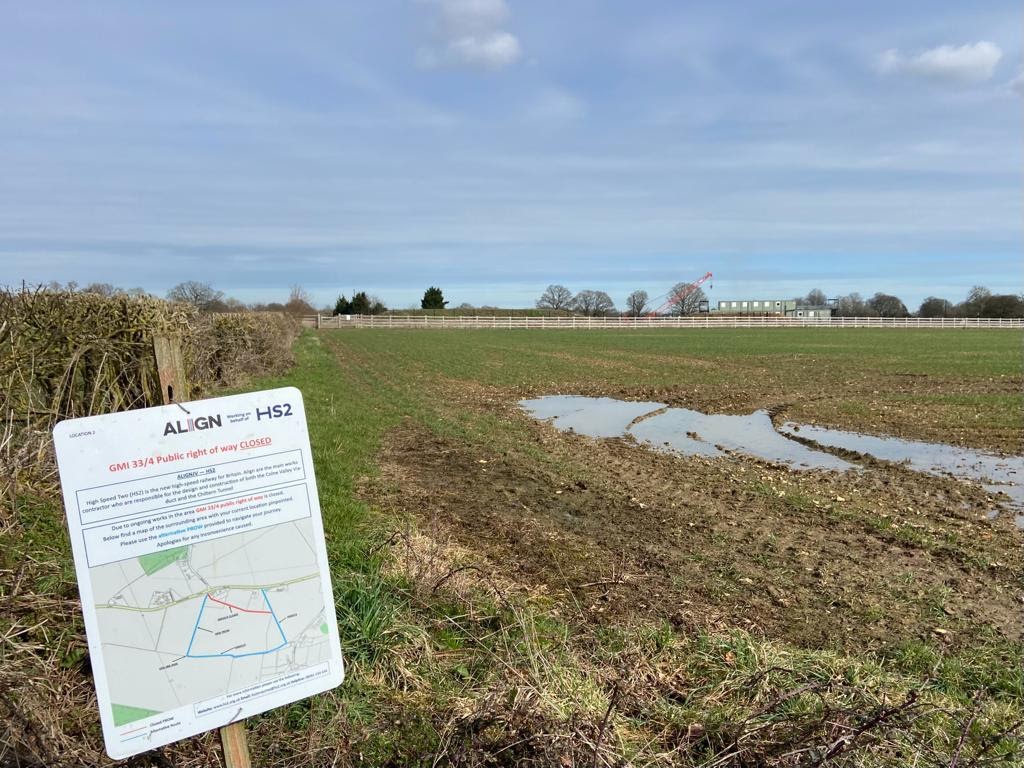
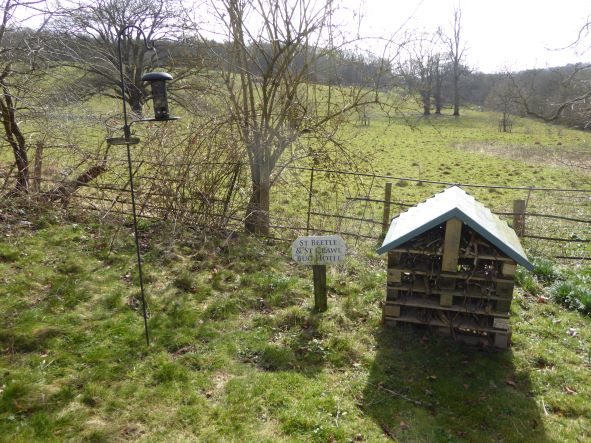
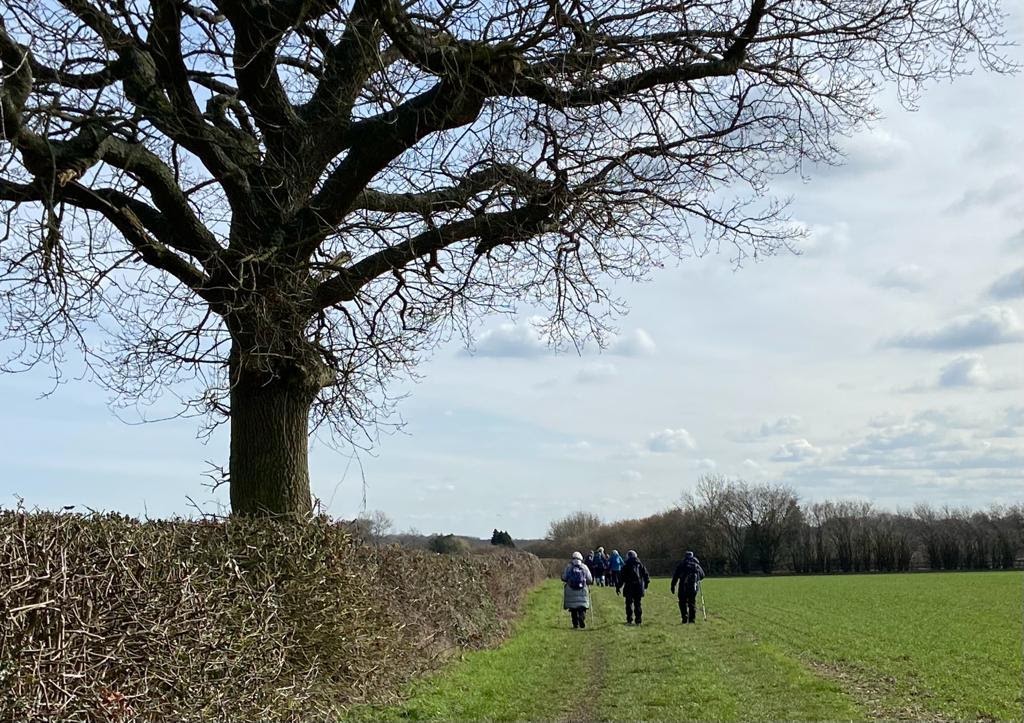
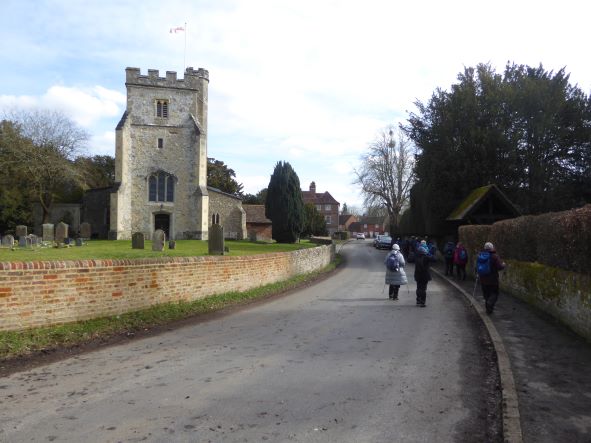
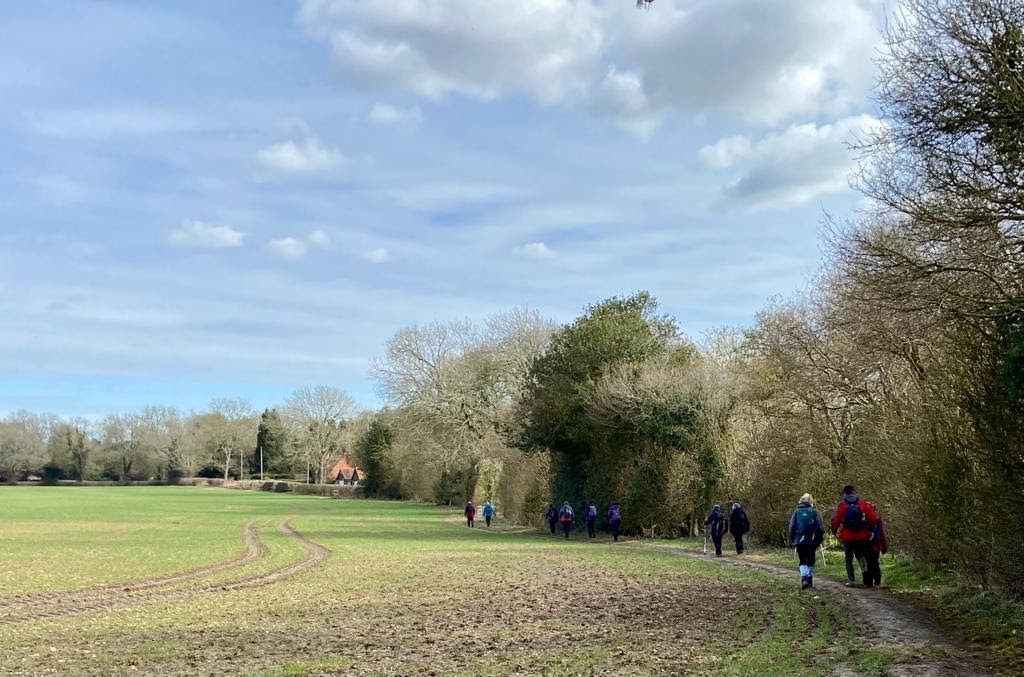
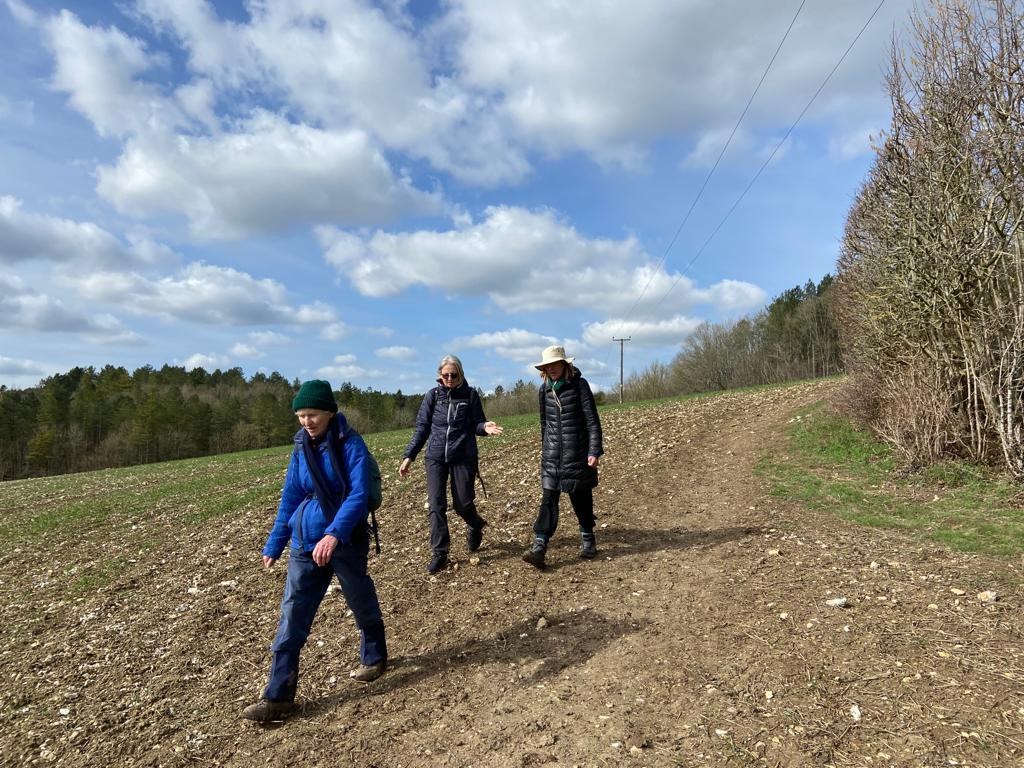
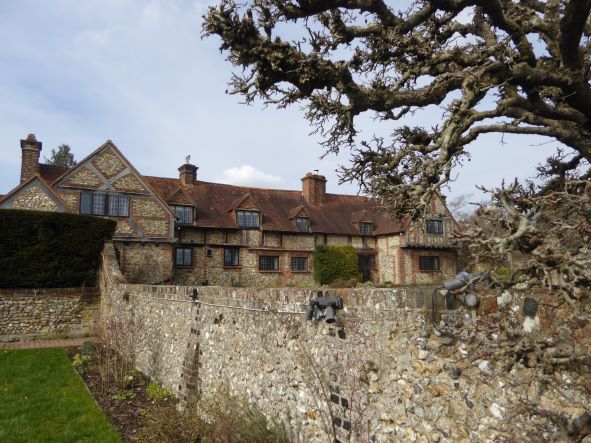
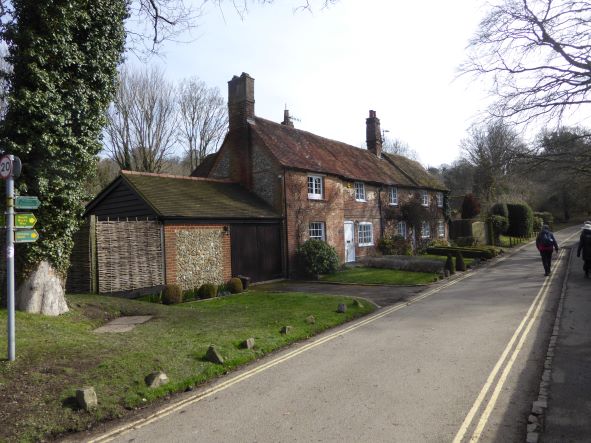
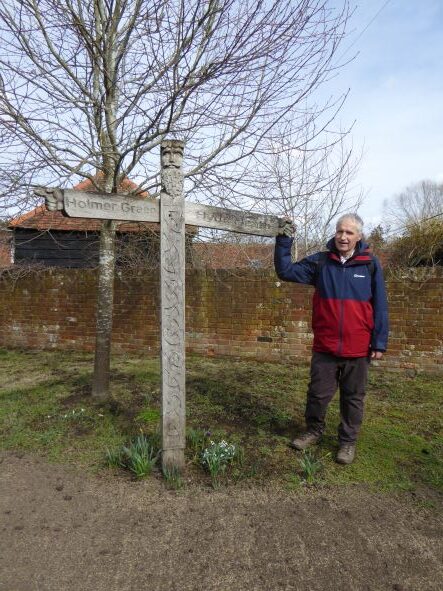
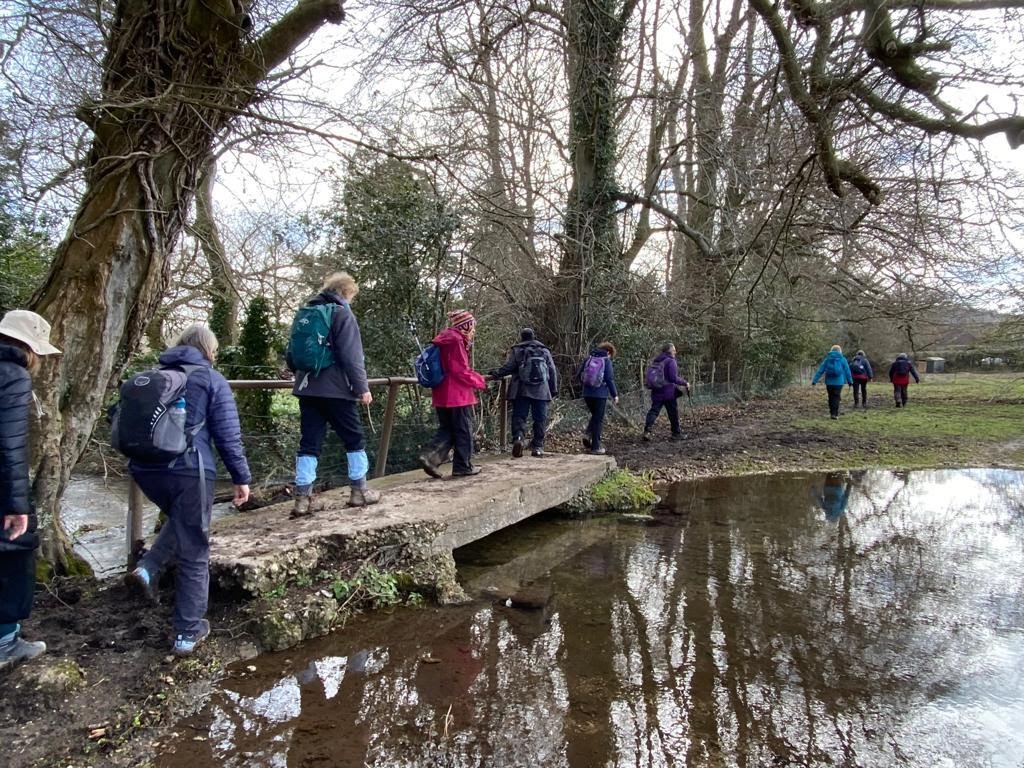
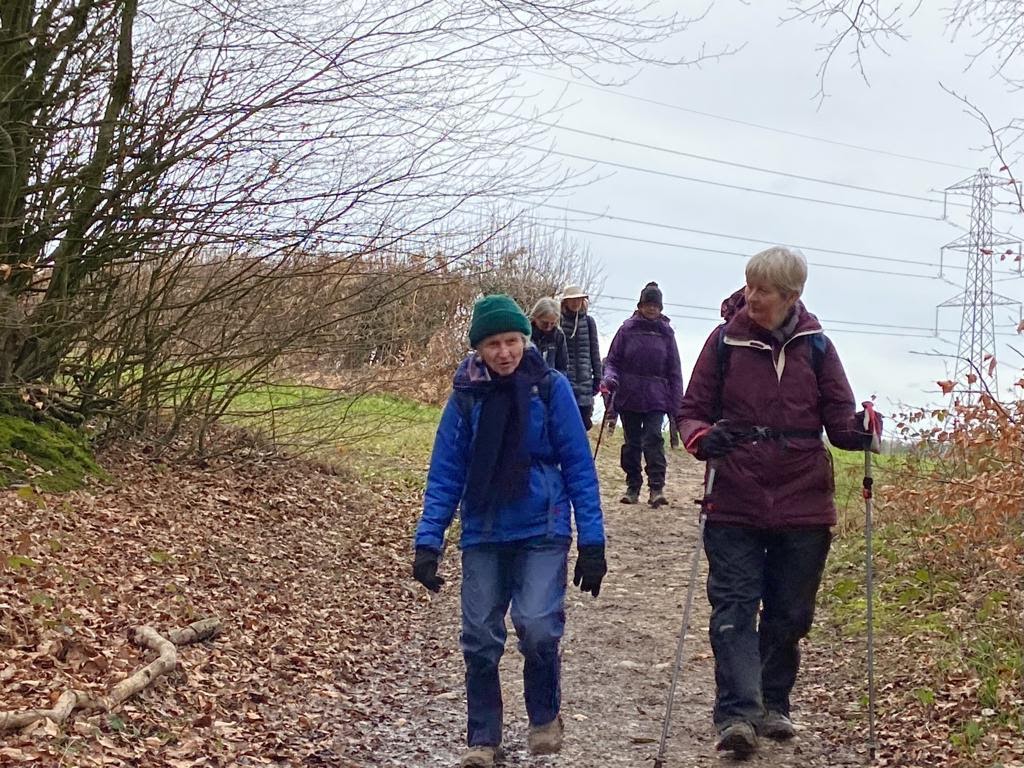
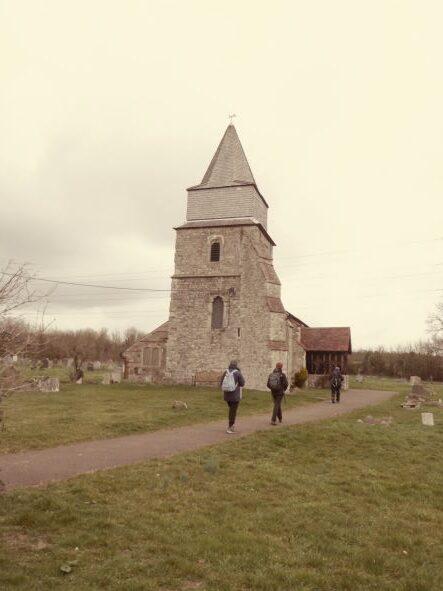
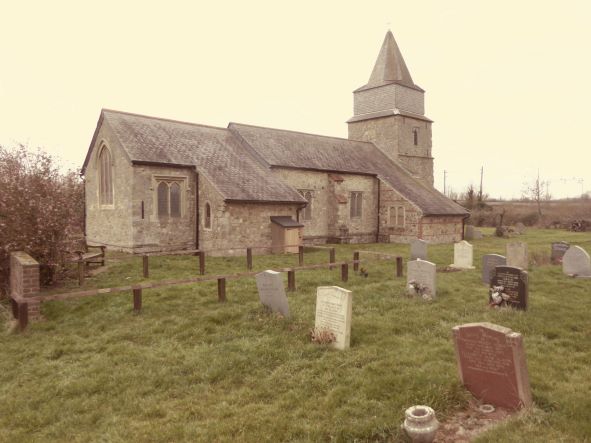
Despite the poor weather forecast, eleven members and two guests assembled at Wraysbury station on Sunday 26th March for a circular walk of 4.5 miles around a quiet corner of the County of Berkshire. Leaving the station car park, the group crossed the Colne Brook by a bridge and then followed it along a muddy path adjacent to a reservoir embankment with grazing sheep. We then went over a railway level crossing via our only two stiles of the day before walking alongside an expanse of water with surprisingly few signs of wildlife. Reaching the village of Hythe End, we followed a busy road for a short while before entering the National Trust Anderwycke Estate and a path down to the Thames opposite Runnymede. A sharp rain shower greeted us at this point and the going was difficult with lots of puddles and copious amounts of mud. Eventually, we left the river bank and passed within sight of the ruins of a priory founded in 1160 for Benedictine nuns. Crossing a number of fields, we reached the grade 2 listed Wraysbury parish church of St Andrews. Unfortunately, it was closed so we moved on through the village to our lunch stop at the Perseverance pub, adjacent to an old windwill converted into a family home. We sat under cover in the pub garden eating picnics as only drinks were available for our party. A quick march then took us the half-mile to the station so that we didn’t miss the hourly service back into London. An enjoyable day despite the weather!
Danny
Photos courtesy of Patricia Burbidge and Almas Jetha
This walk was laid on at very short notice to replace a walk that had had to be cancelled because the leader was recovering from covid. An old Poly Rambler favourite, it was offered because it didn’t require much planning and is always a lovely walk. After the deluge of the day before, the weather was looking promising as 14 Poly Ramblers emerged from Otford station into bright sunshine. Fortunately, it stayed dry for the rest of the day. Continue reading OTFORD TO EYNSFORD – SATURDAY 25 MARCH→
We were surprised when, on taking a turning out of Bexley station, we found the riverside walk closed off due to works. It had been open one week before, with no notice displayed about future closure. Teaming up, we planned an alternative, to bypass the problem and get back on our route. A bit of walking along a road and we were able to join the Loop again. The weather was fine and our small group enjoyed the woods, riverside and some galloping horses. A bit of mud here and there slowed us a little. We sat at the Ha Ha at Sidcup House and had our sarnies with a coffee from the restaurant behind us, which was doing good trade, it being Mother’s day.
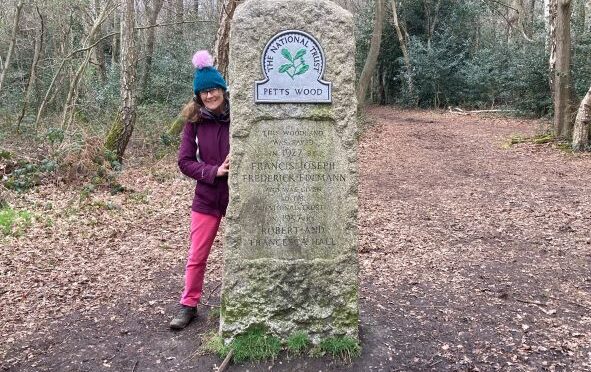
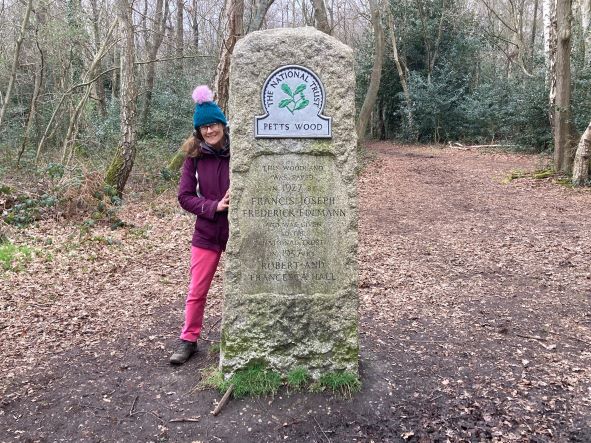
After lunch we crossed into Chislehurst common and then into Petts wood which provided some photo opportunities. That done we carried on to Petts wood station and made good time to catch trains homewards to Charing cross or Victoria.
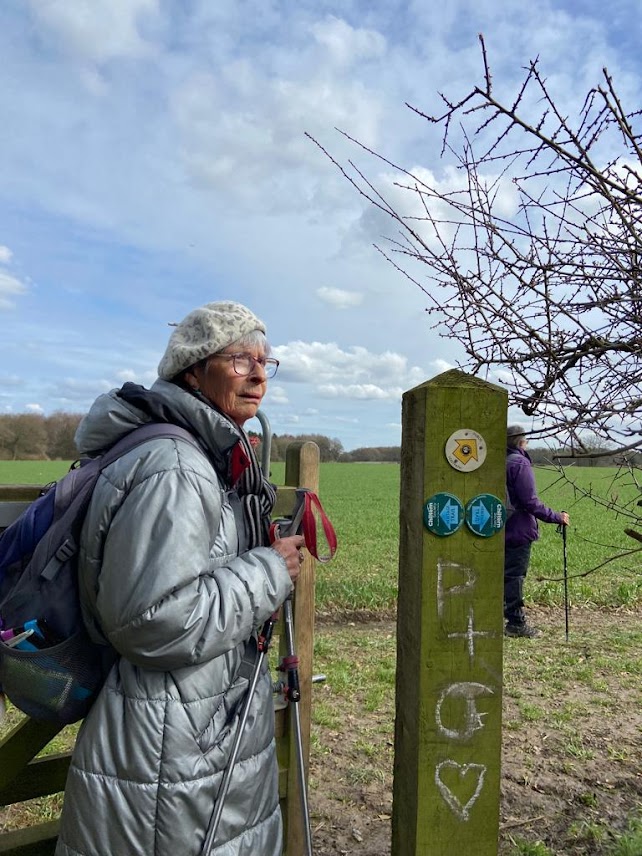
There were twenty three of us on this 10 mile walk over the hills to Amersham. I was delighted to see so many ramblers come along after almost three days of gloomy wet weather which didn’t clear until Friday afternoon. We set off from the railway station passing the 14th c. parish Church of St Peter & St Paul and then climbed to the top of the hill which has some very fine views of the surrounding countryside. The going was quite soft and rather muddy in places but the heavy rain I was fearing didn’t appear. We descended the neighbouring valley to the ancient village of Little Missenden, crossing the busy A413 on the way. We visited the St John the Baptist Church, parts of which date back to the 10th c. and after removing our muddy boots we admired the medieval frescoes which can be seen inside the church.
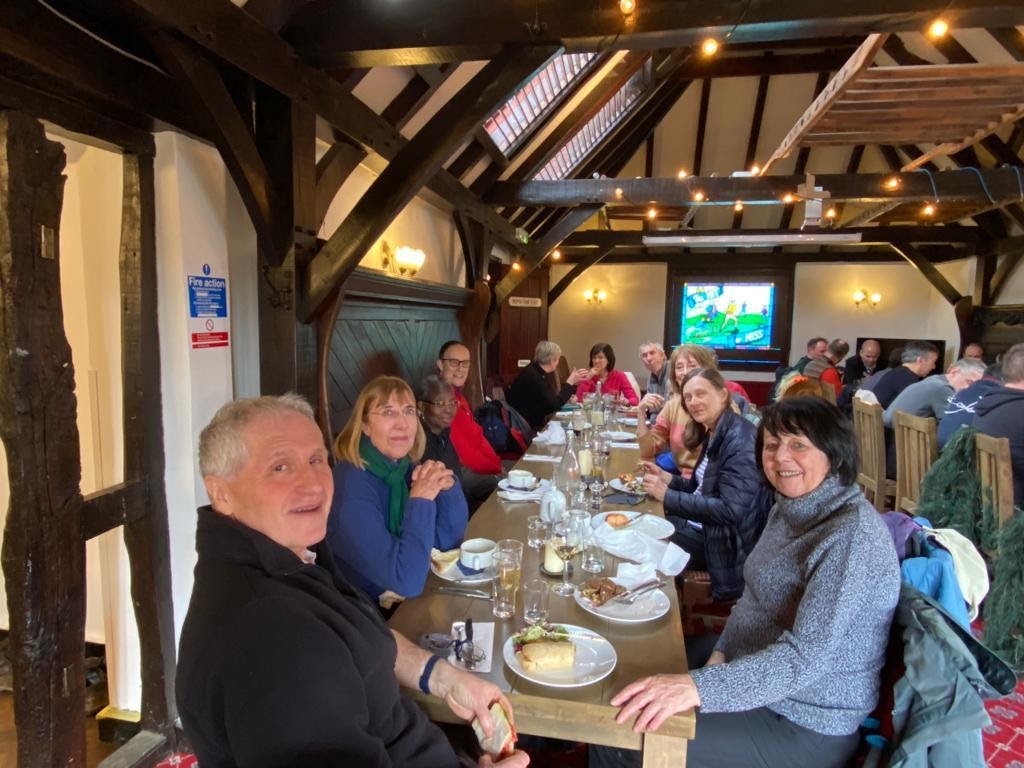
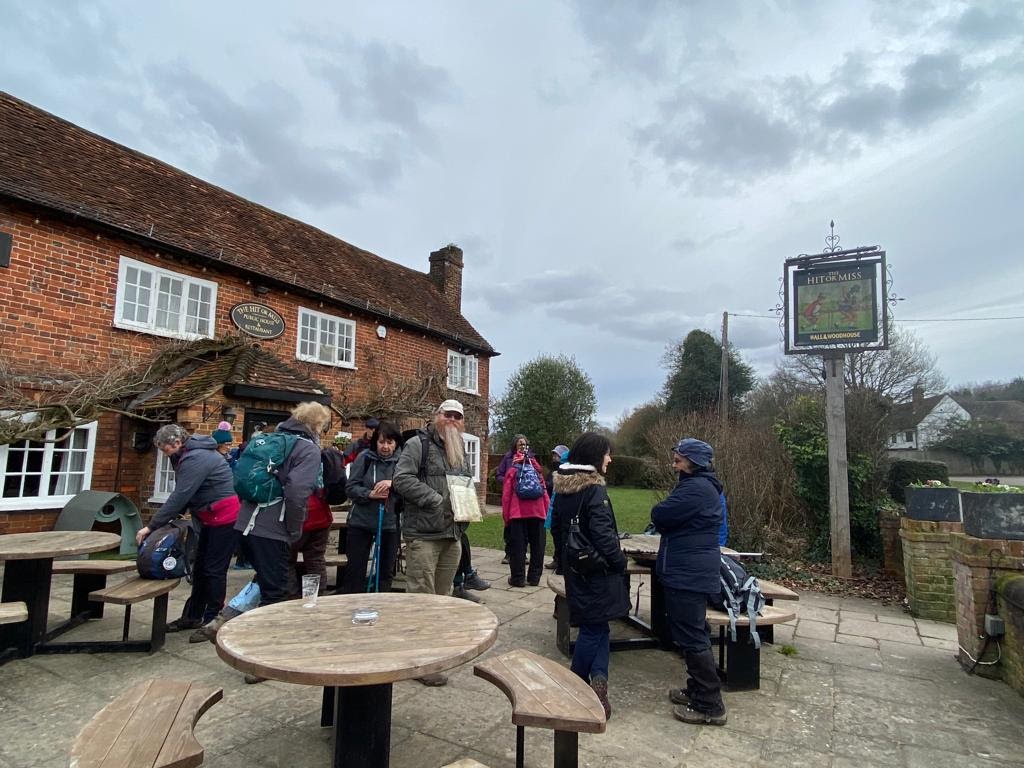
After leaving the church we climbed a long incline up to Beamond End, stopping for a quick snack at about 1.15pm. We crossed the busy A404 safely and then we were amongst the beech trees of Penn Wood. After leaving the wood it was time for a well deserved lunch, either a picnic on the green or a meal at the Hit or Miss Pub nearby. In the pub and sat next to us was a group of men who said they were a ‘Dad’s Group’ each person was dressed to represent a different London underground station. One man was dressed as an angel for Angel Stn, another as a baker, for Baker Street Stn etc!
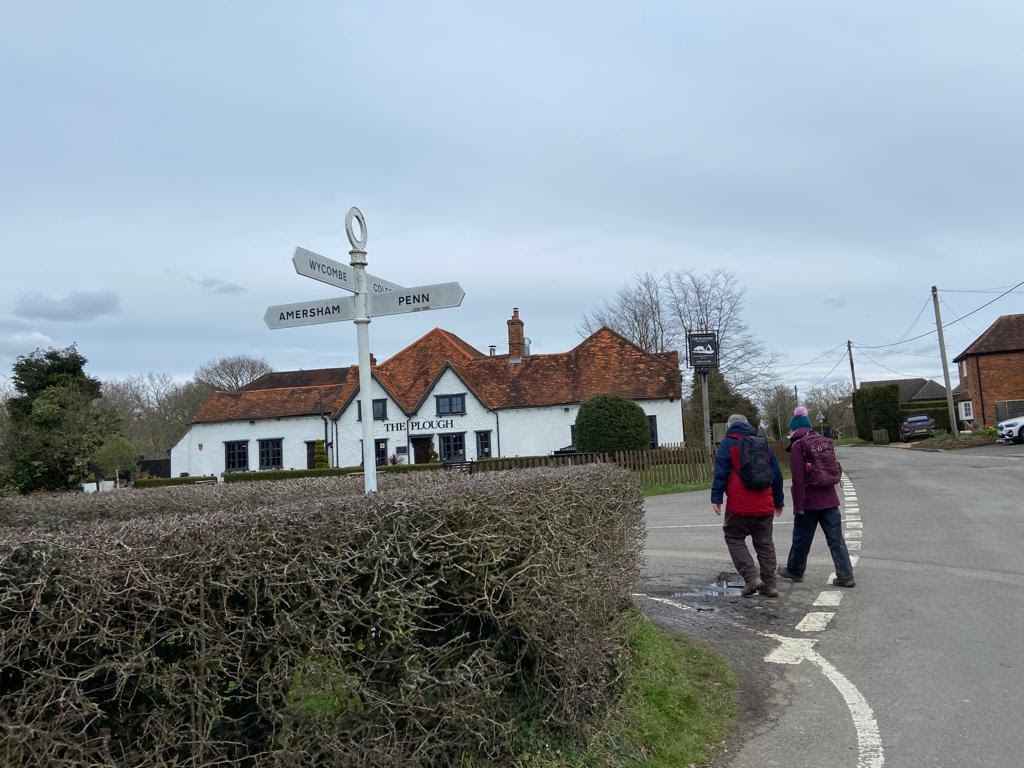
We were over half-way now and set off to the village of Winchmore Hill across the fields and through the woods. It was quite muddy going in places. Then on to Coleshill where we passed a 19th c. Church, then down the road for a while. Still no rain! And making good time. We emerged via a country path onto fields with a a fine view of a distant Old Amersham in the valley below us. We arrived in Amersham at 16:45 and some of us visited the small and crowded tea shop which was closing in 15 minutes. Others headed directly up the steep hill to the station. We had been lucky with the weather. It had been a great day out.
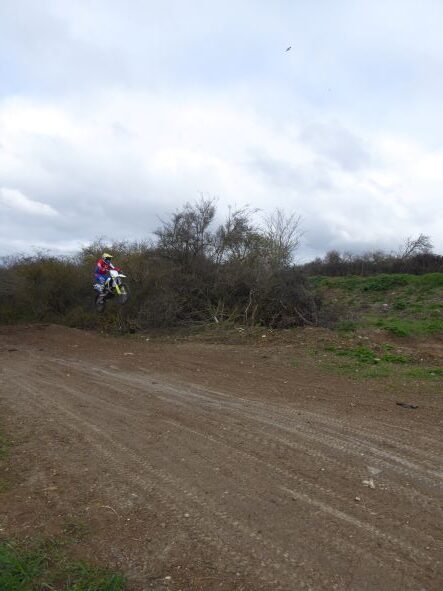
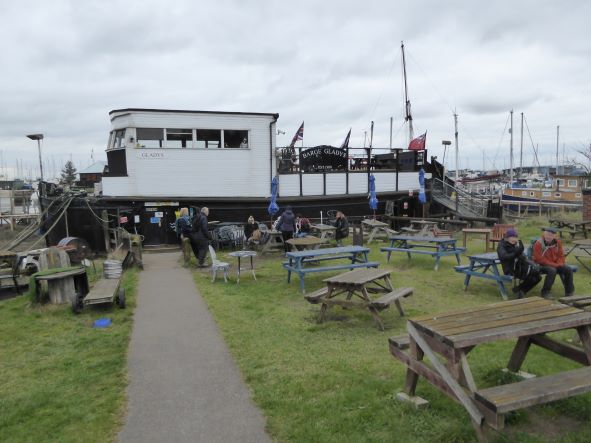
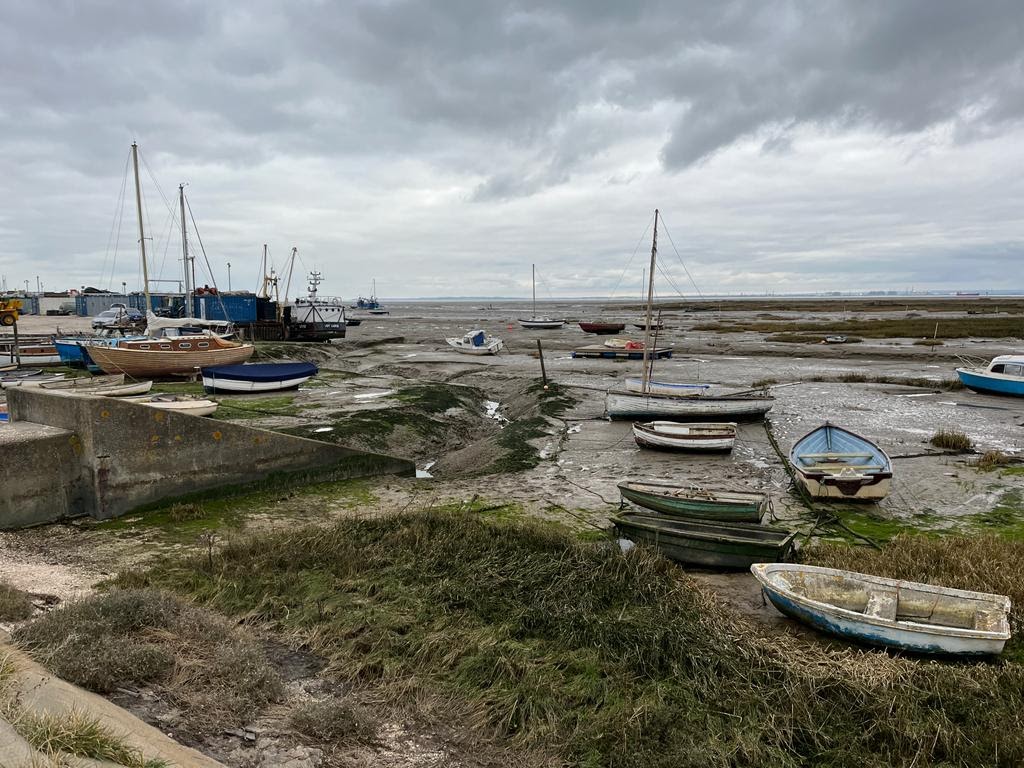
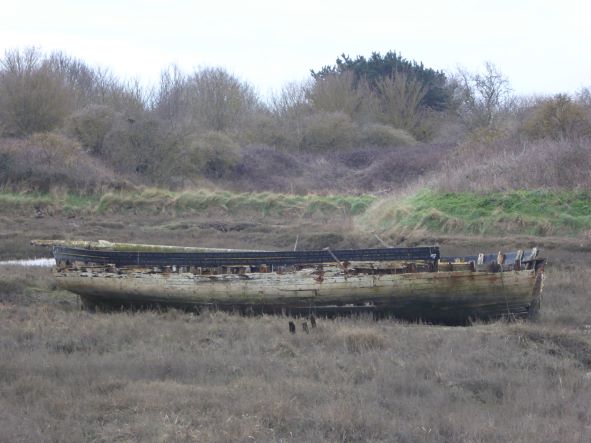
Twenty two Poly Ramblers turned up for the fourth and final part of the Thames Estuary Path – or so they thought! It was a grey, cold day and, although the sky got quite dark, rain did not materialise. And neither did the mud I experienced in the first field when I did the recce. After successfully counting participants, we were soon out of Pitsea and walking in fields along the railway. We quickly arrived at St Margaret’s Church, Bowers Gifford, an English Heritage historic Grade 2 listed building which dates back to Saxon times and is recorded in the Domesday Book commissioned by William I in 1085. It is a rare example of a working ‘marsh located’ church. Leaving the church, we continued through the RSPB Bowers Marsh Reserve and reached Benfleet Creek after walking under the A130. We walked on the sea wall accompanied by the noise of motorbikes riding on a track alongside the footpath. We arrived at Benfleet, our lunch stop. Half the group went to the Hoy and Helmet pub to eat in the warmth. The other half had a picnic (watching an avocet, a curlew and other birds we could not identify) and a drink at quirky Barge Gladys.
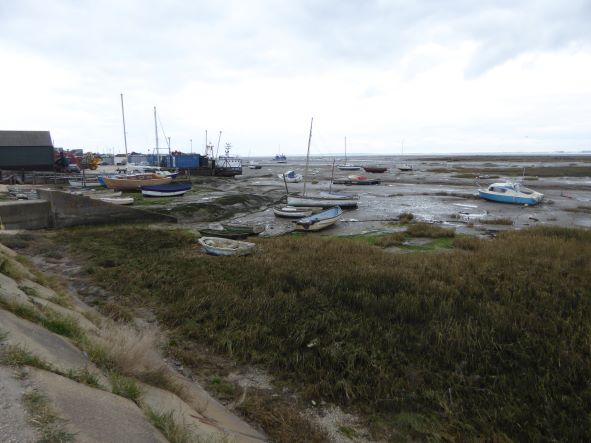
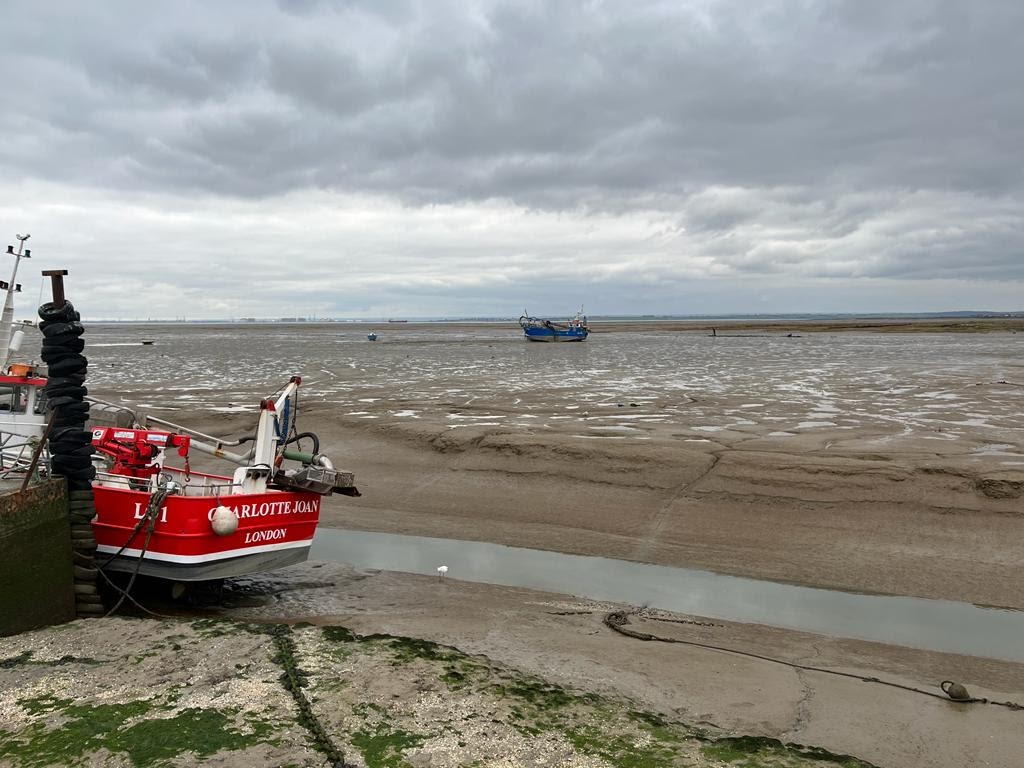
We all reunited after lunch and then entered Hadleigh Country Park following Benfleet Creek – which separates the mainland from Canvey Island – along marshes. We could see the ruins of Hadley Castle in the distance. The castle was begun around 1215 by Hubert de Burgh but extensively refortified by Edward III during the Hundred Years War. We continued along the sea wall parallel to Two Tree Island, a nature reserve, and Leigh Marsh before reaching Old Leigh, passing shellfish shacks where a few people stopped to make some purchases for dinner. We walked along the harbour and followed pretty Old Leigh High Street then continued along the busy sea wall to reach Chalkwell station with only 10 minutes wait for the train. Someone mentioned her surprise that the walk did not end in Southend. When I checked the information about the walk, it said the walk is from Tilbury Town to Southend – something that I had forgotten since we started the walk over a year ago. I will remedy this for the purists with another walk in late autumn.