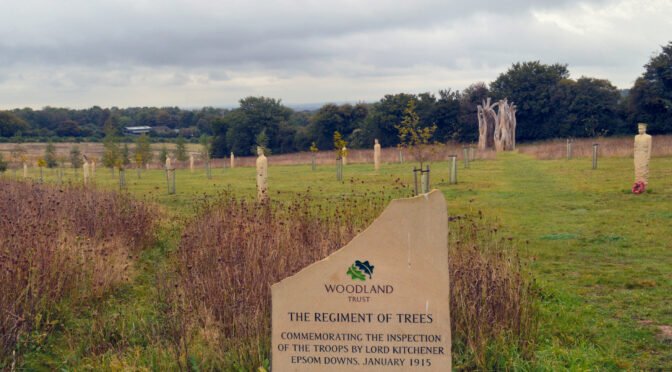
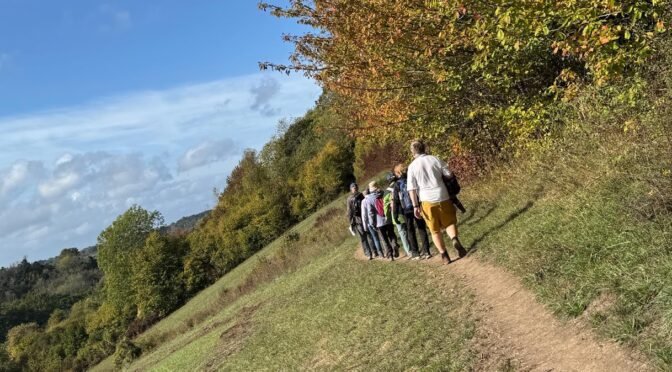
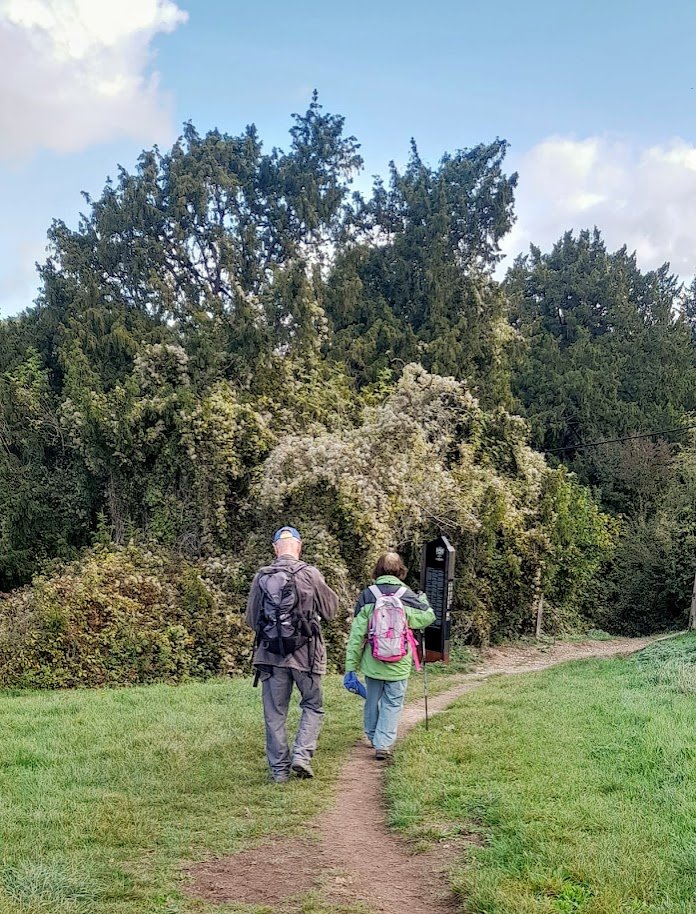
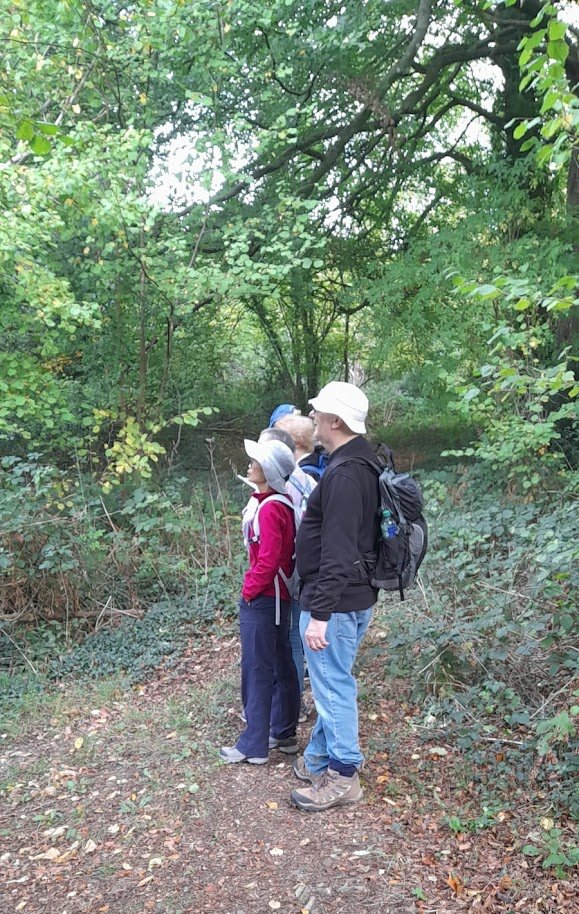
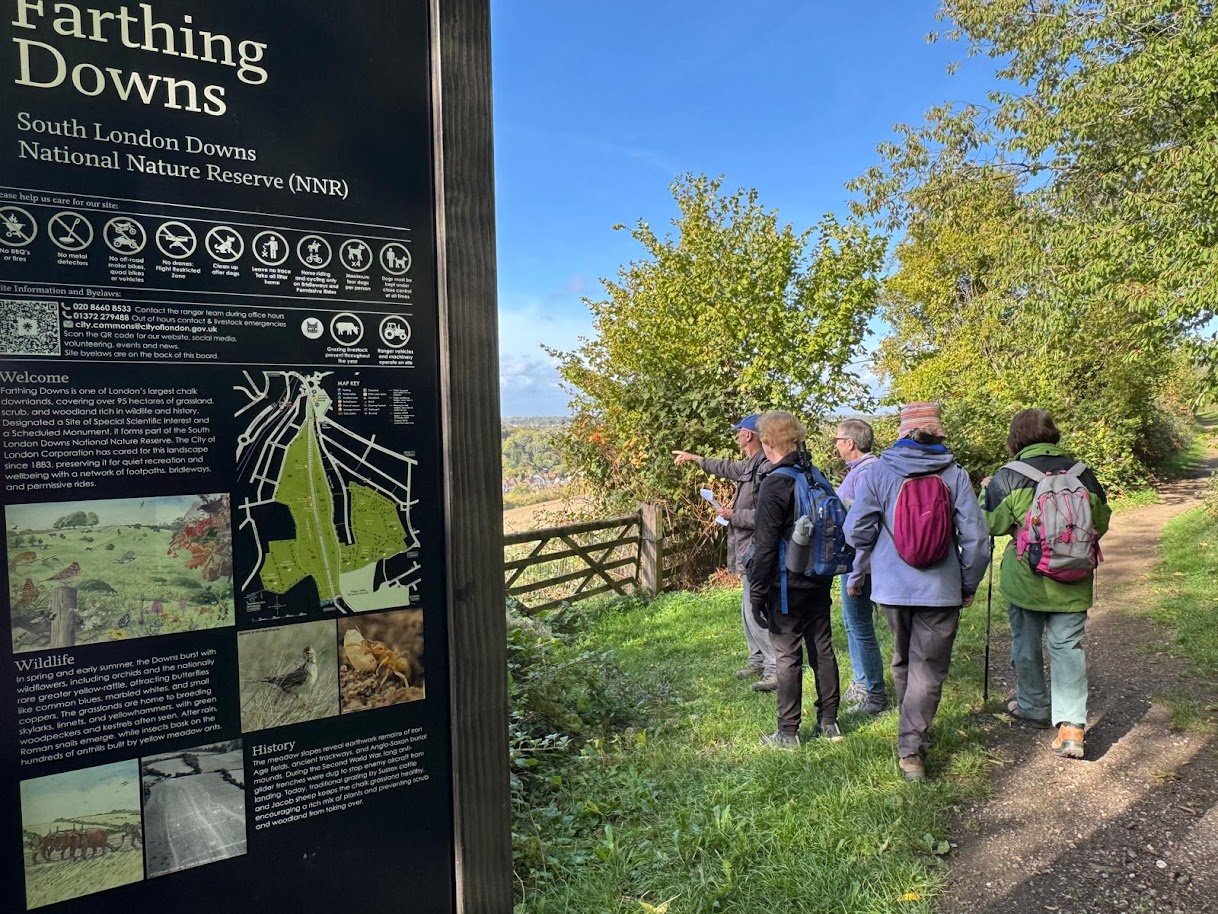
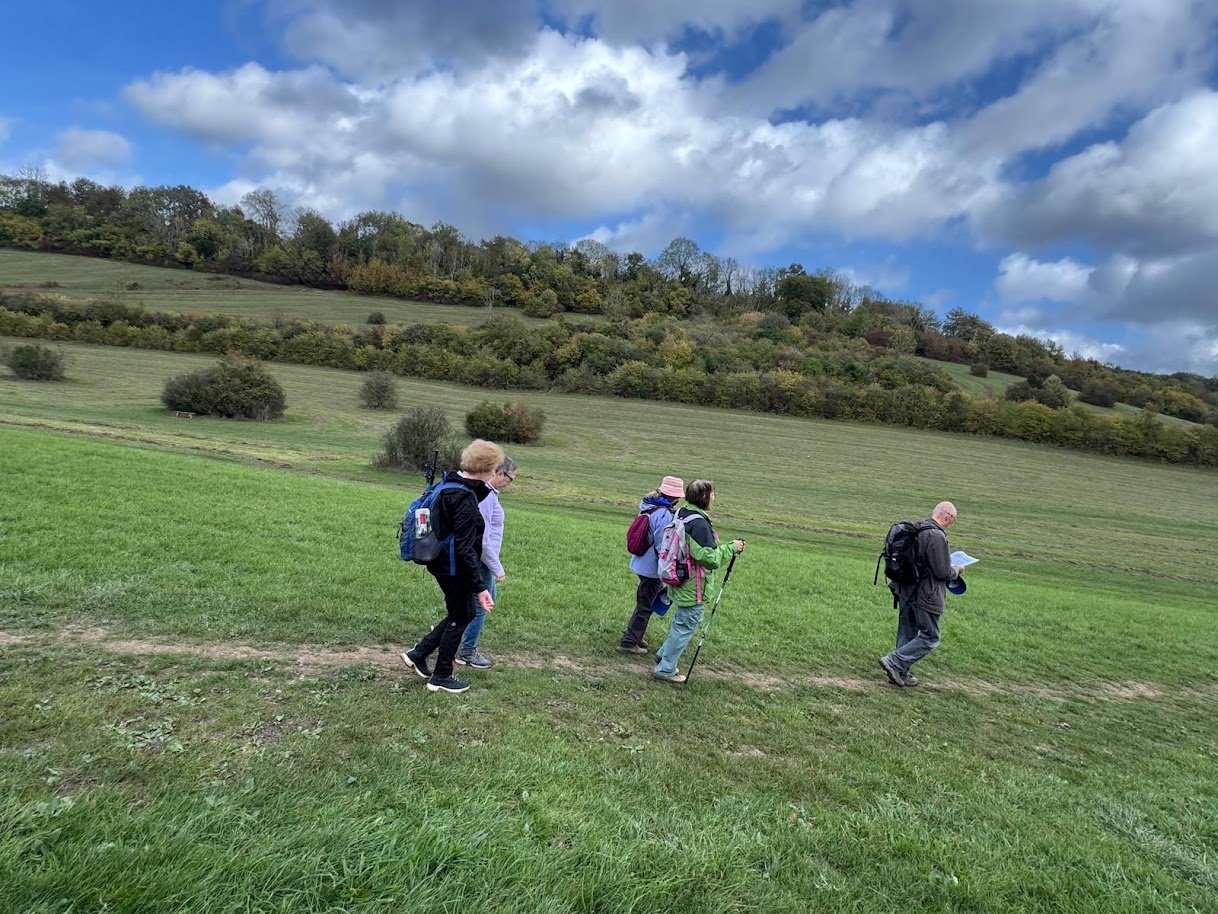
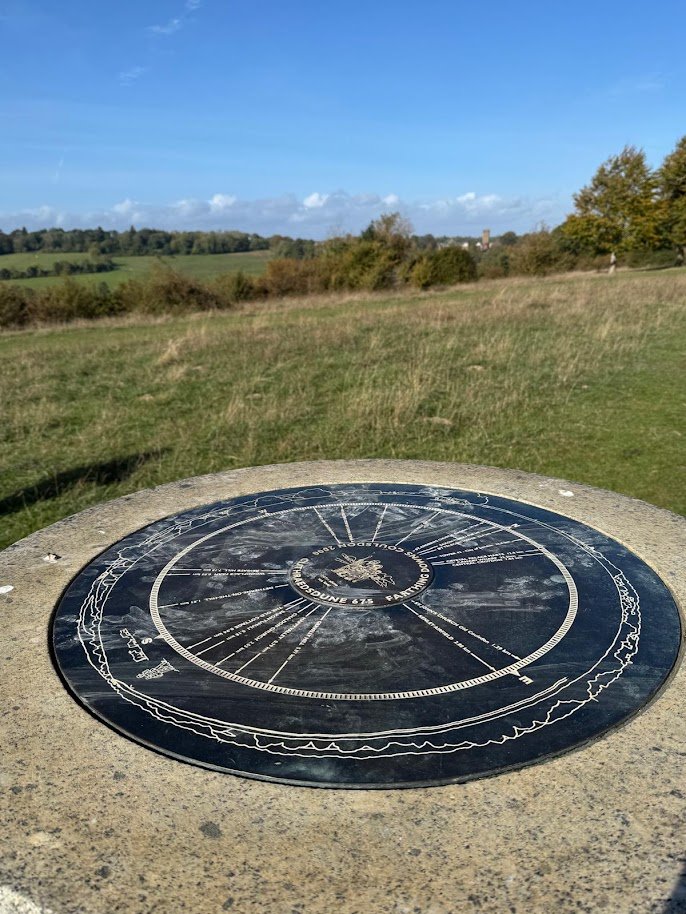
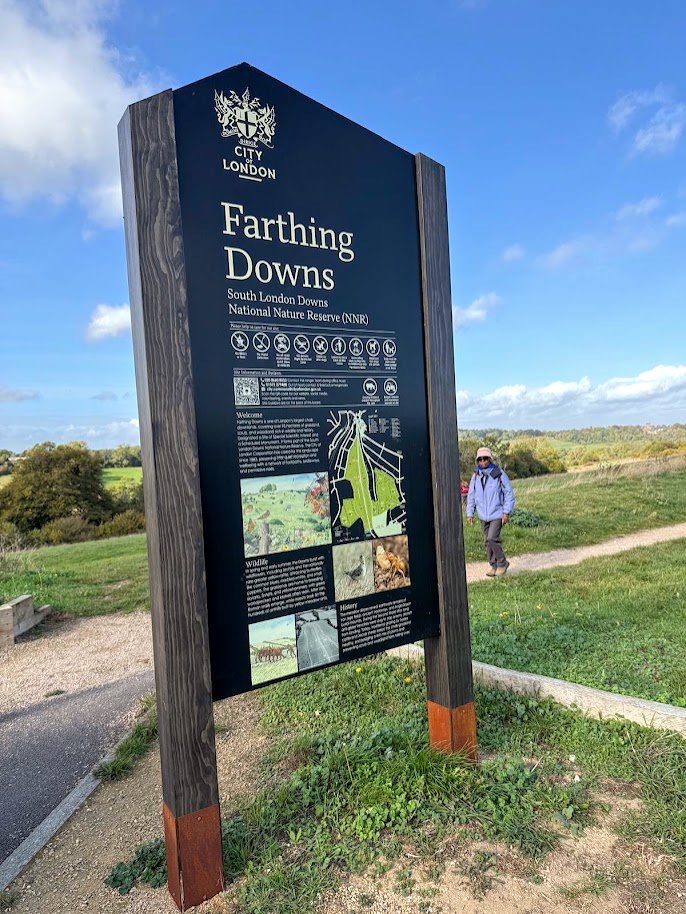
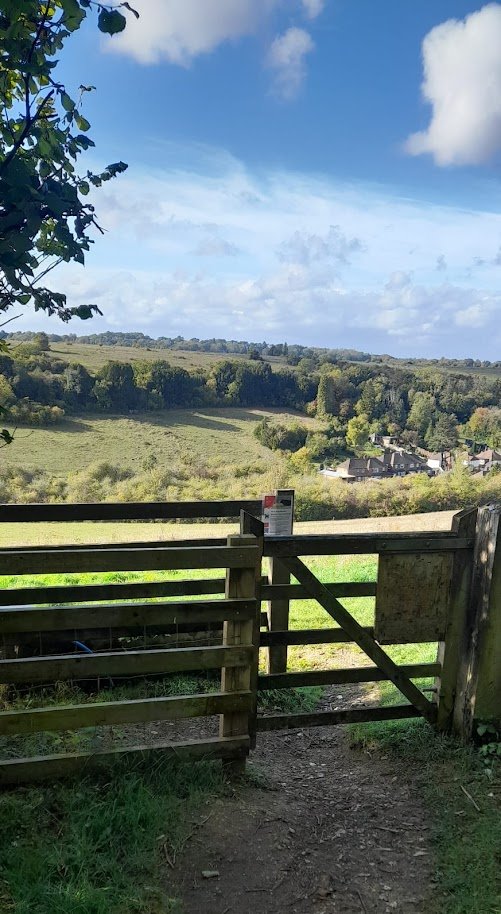
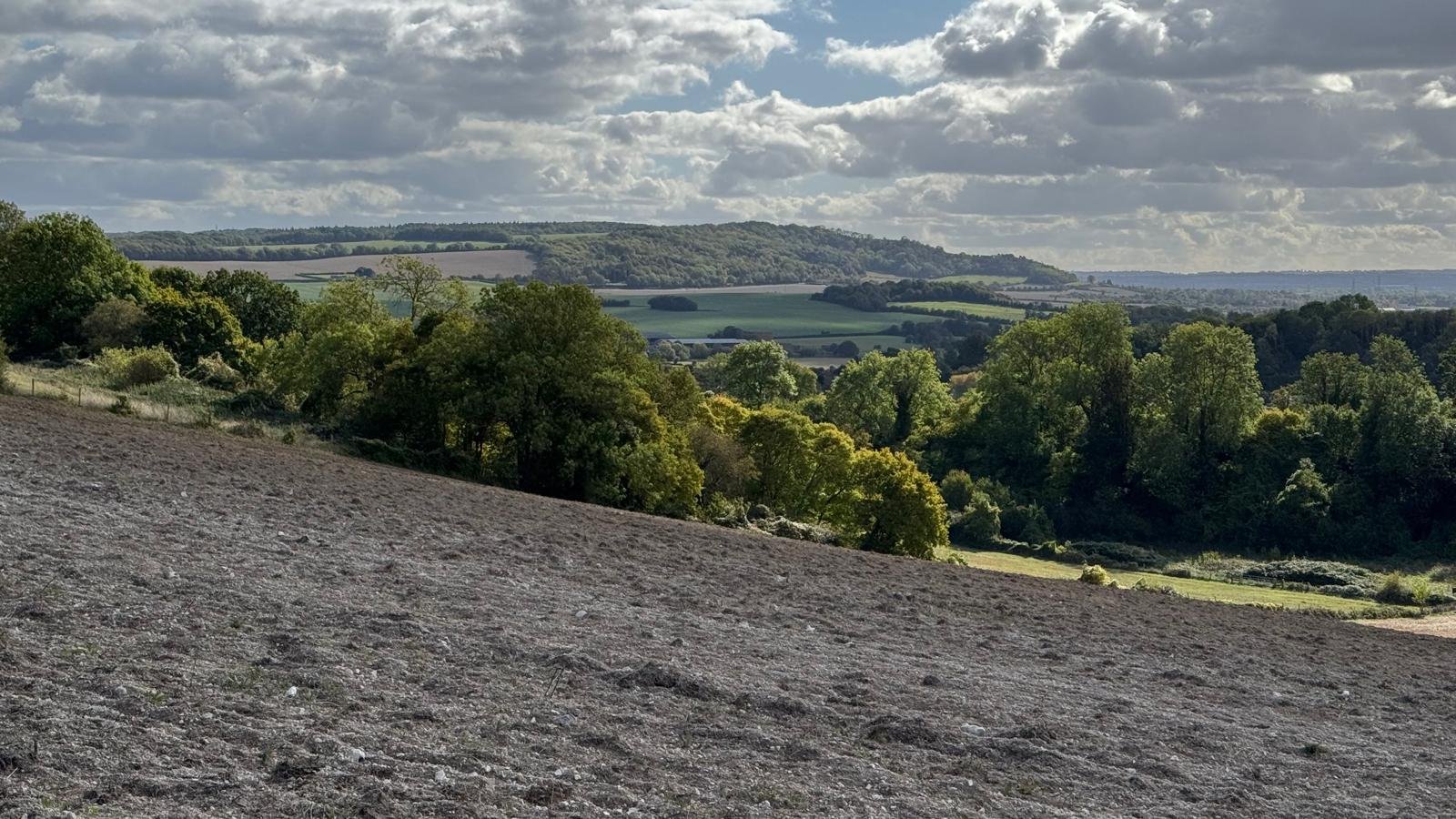
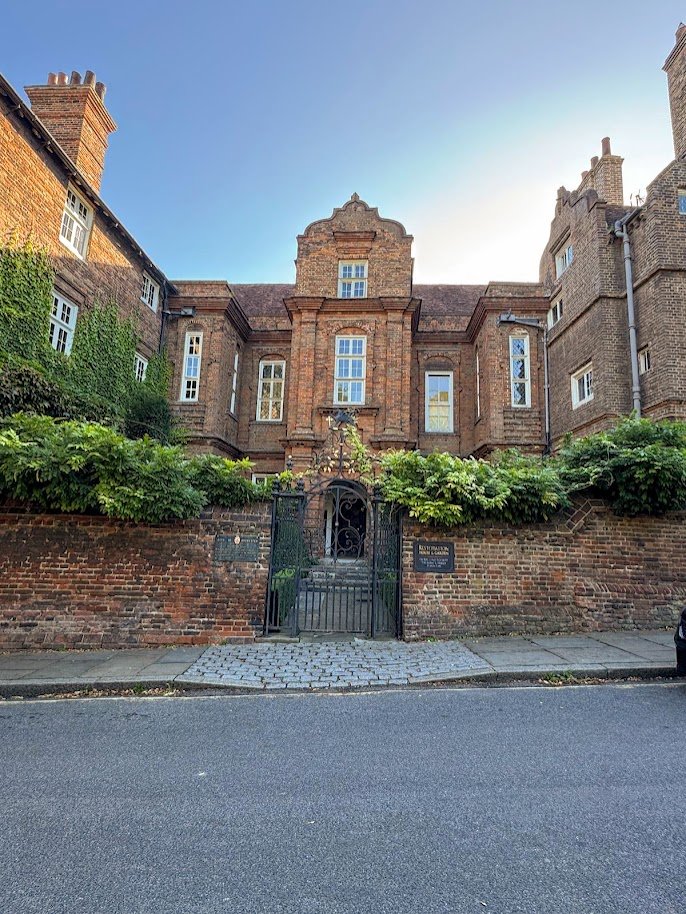
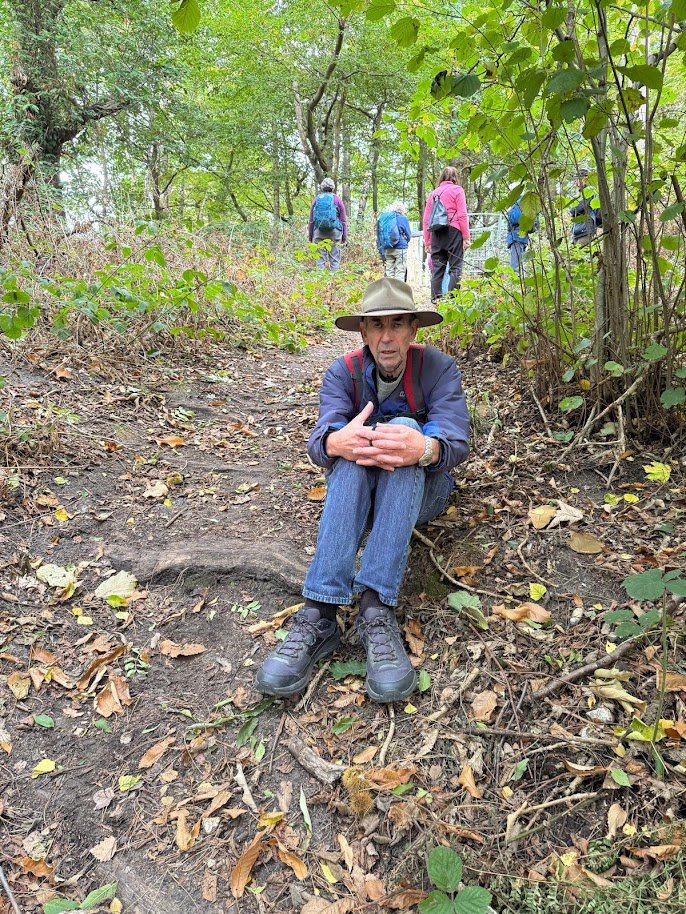
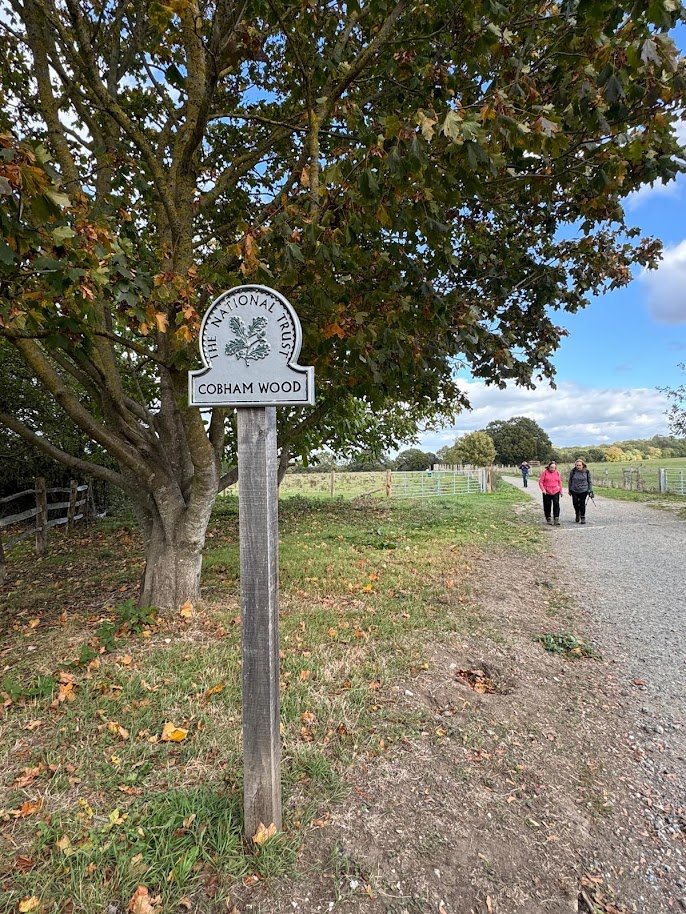
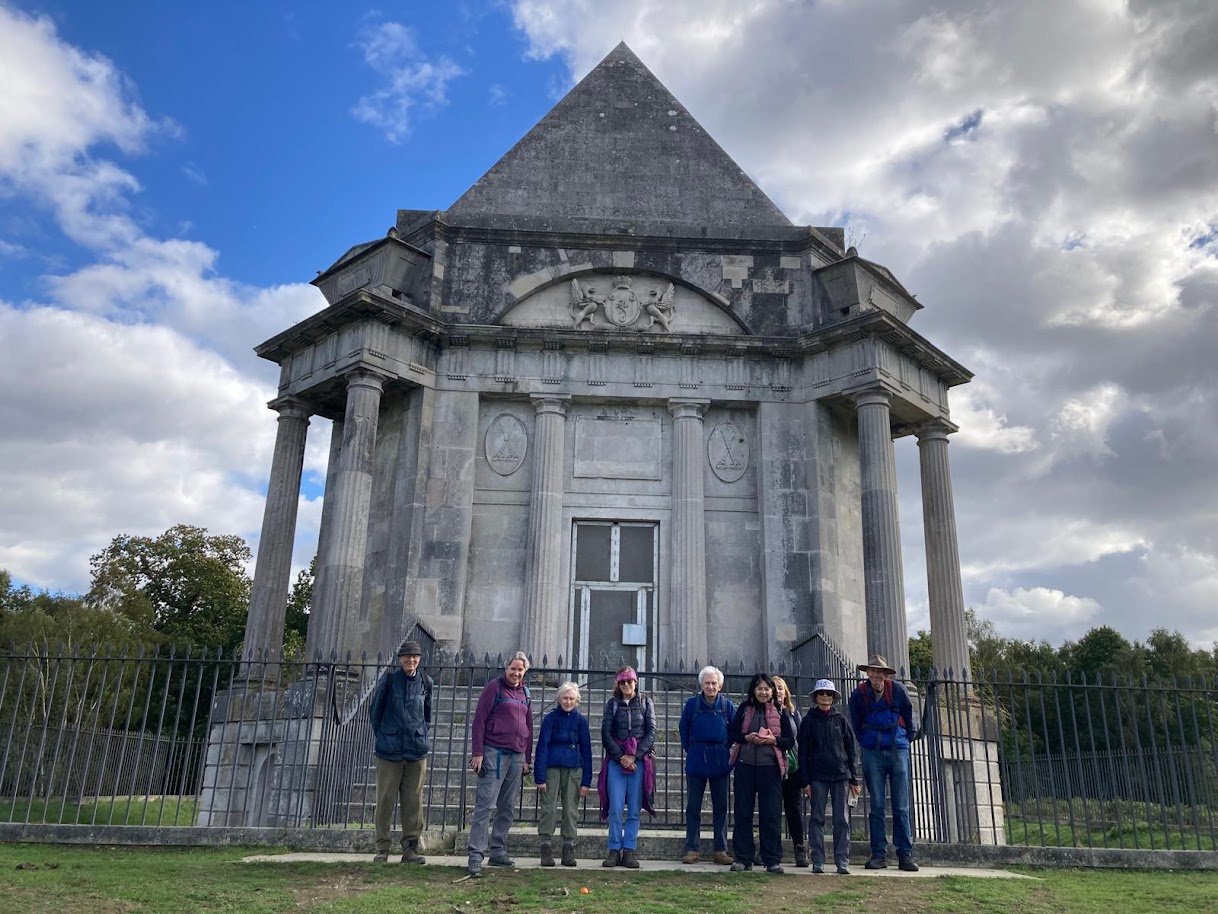
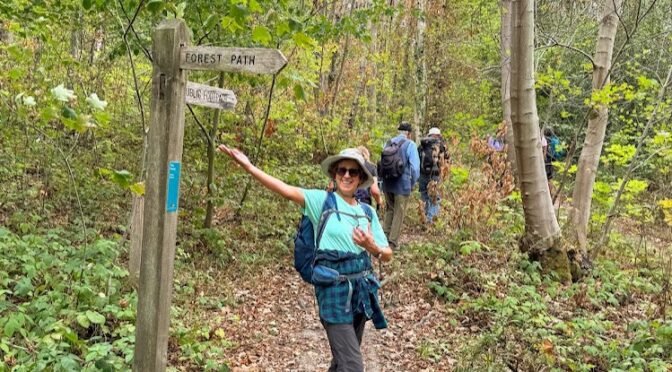
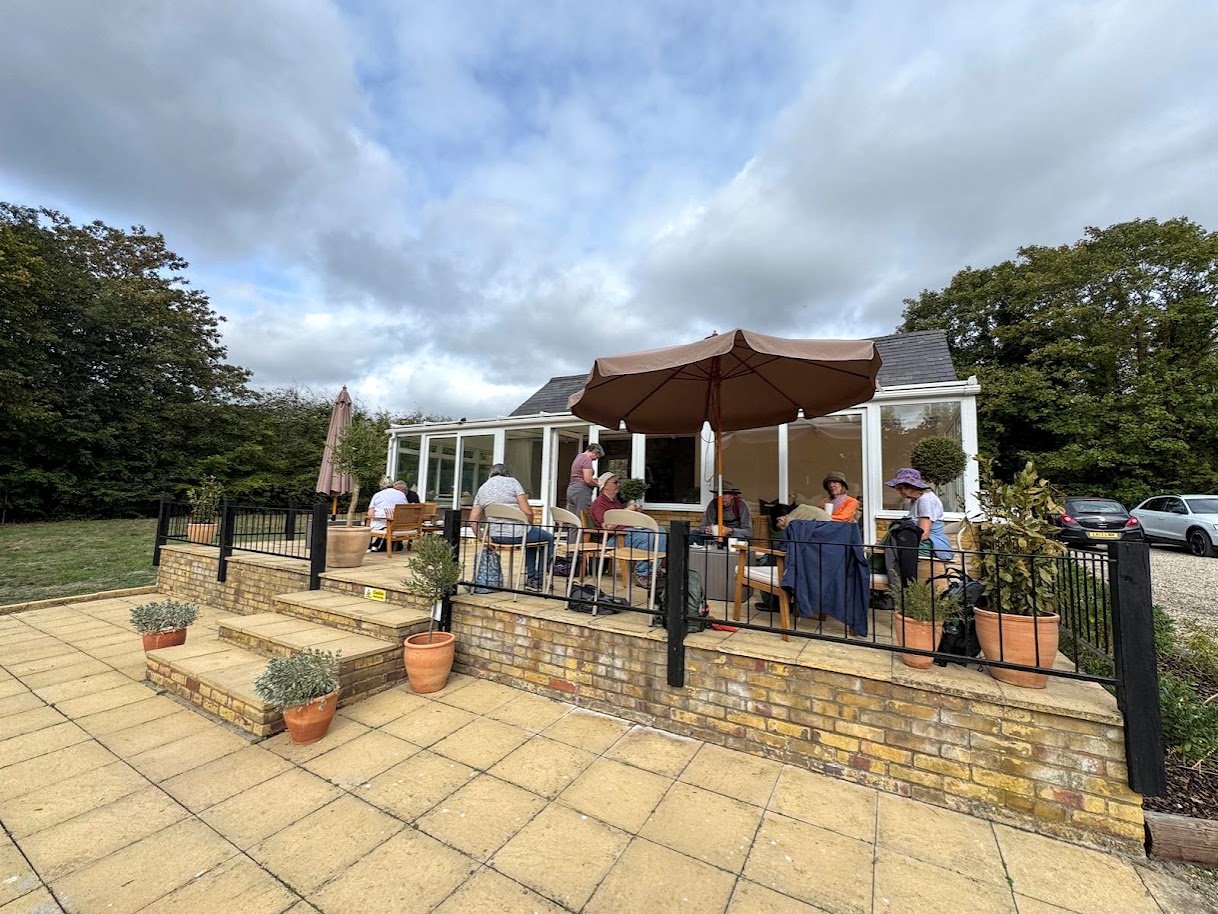
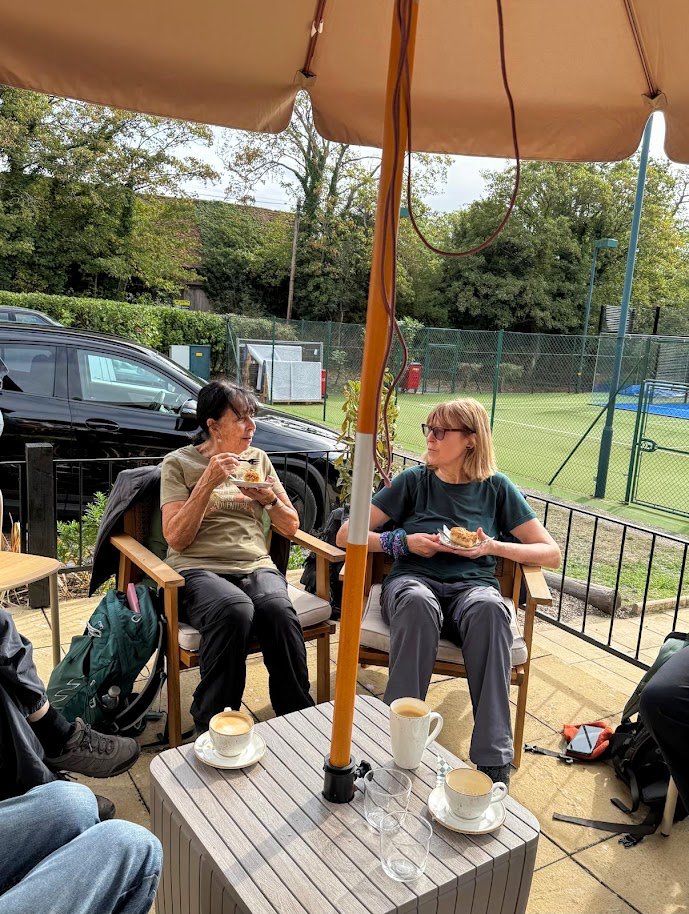
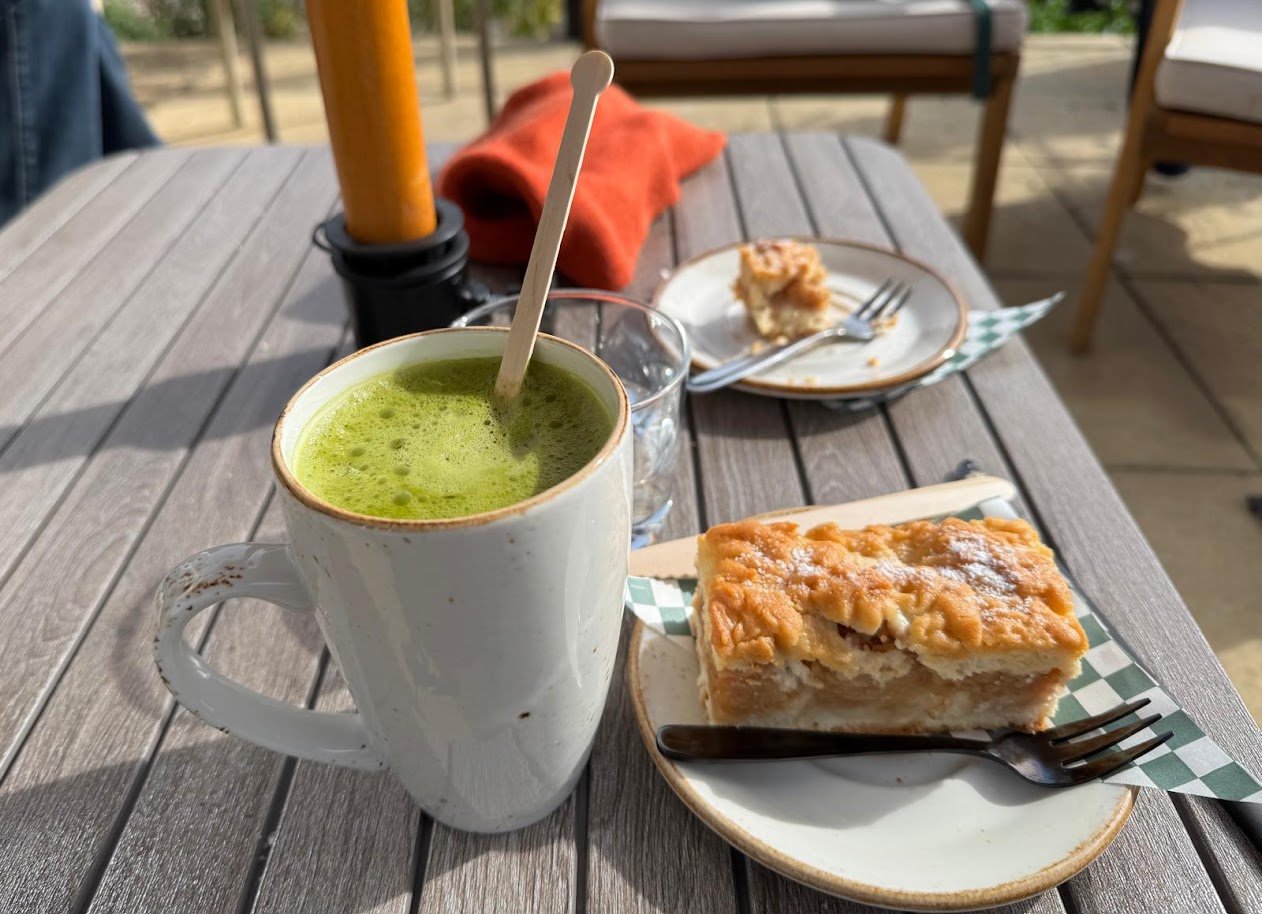
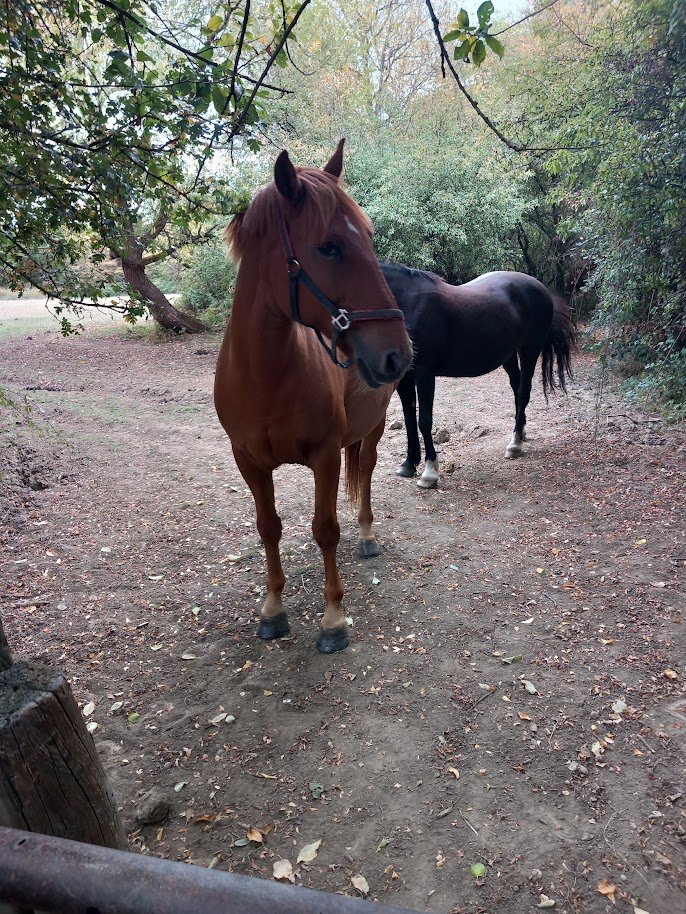
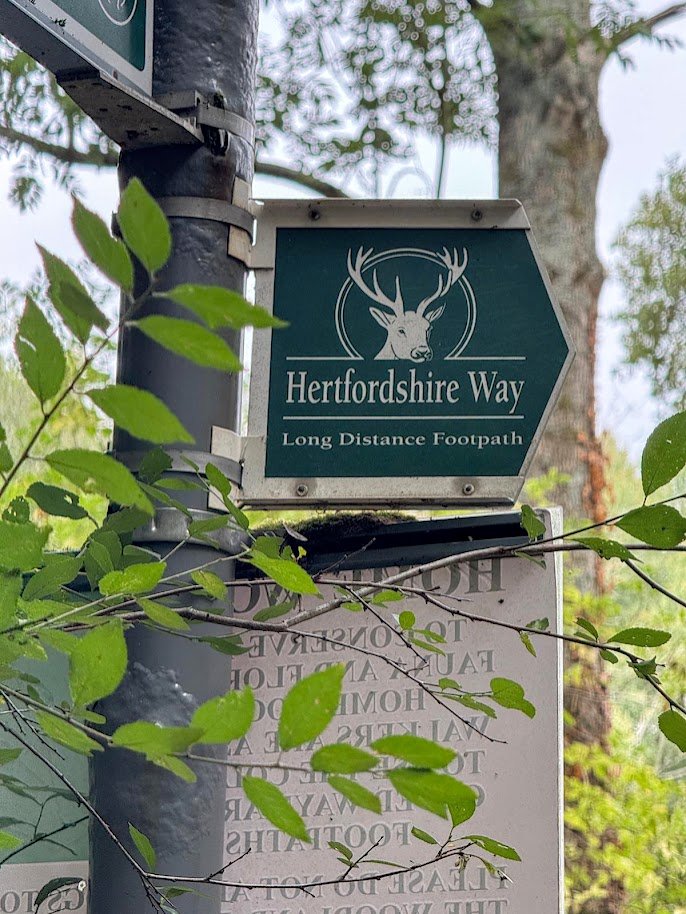
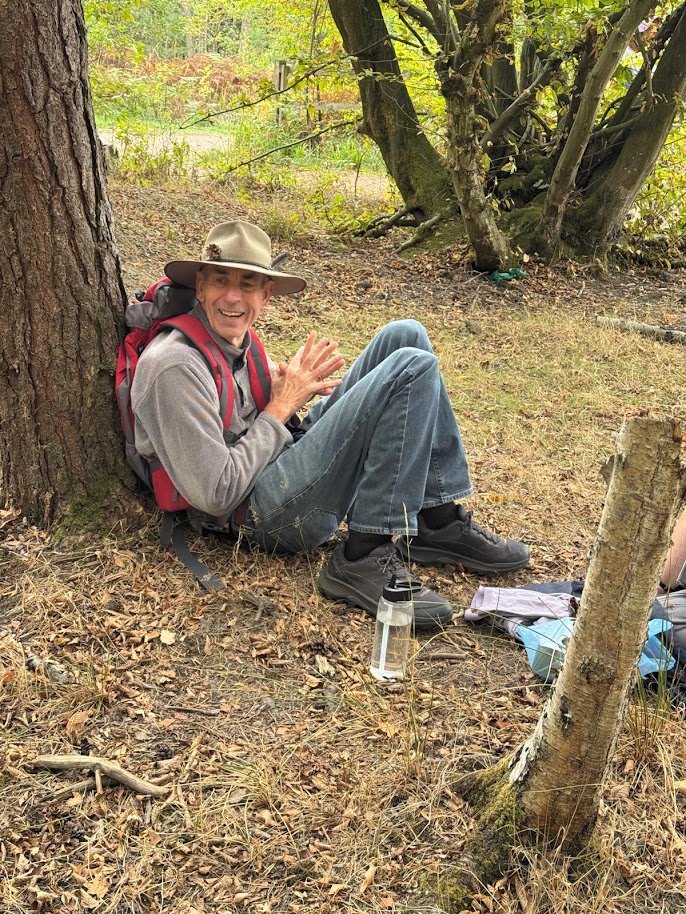
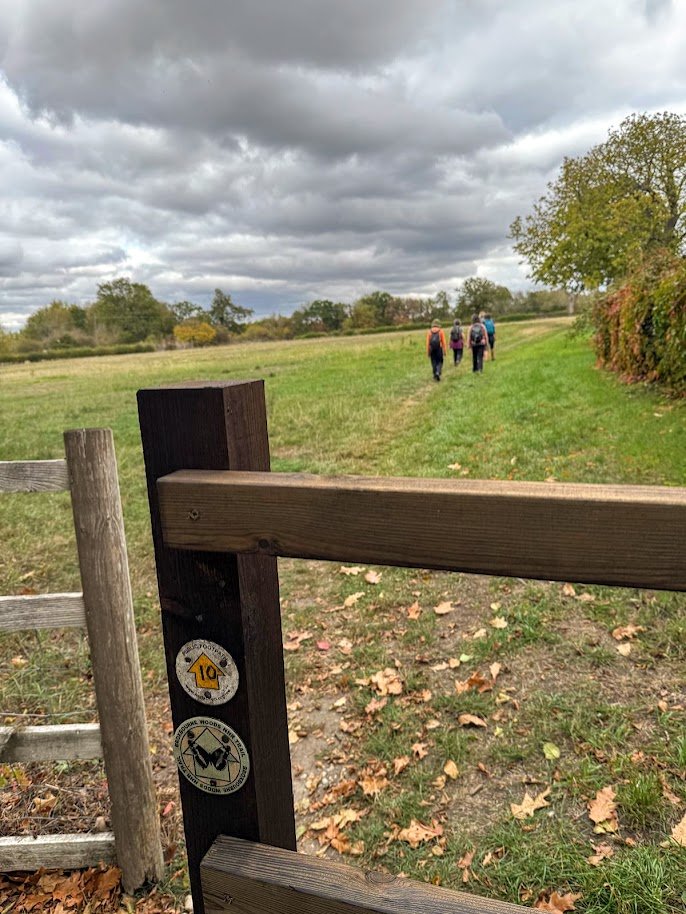
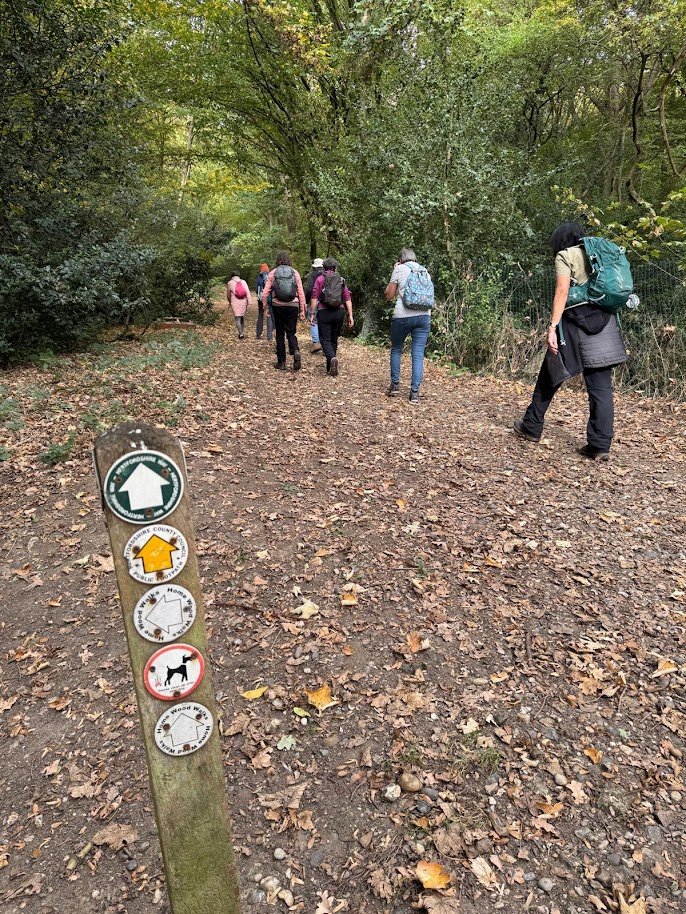
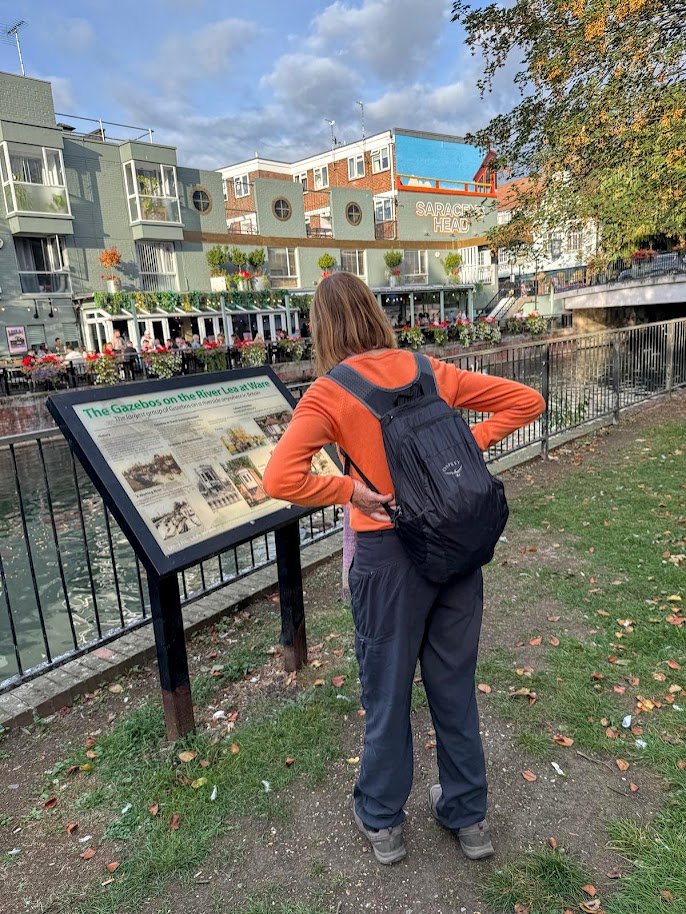
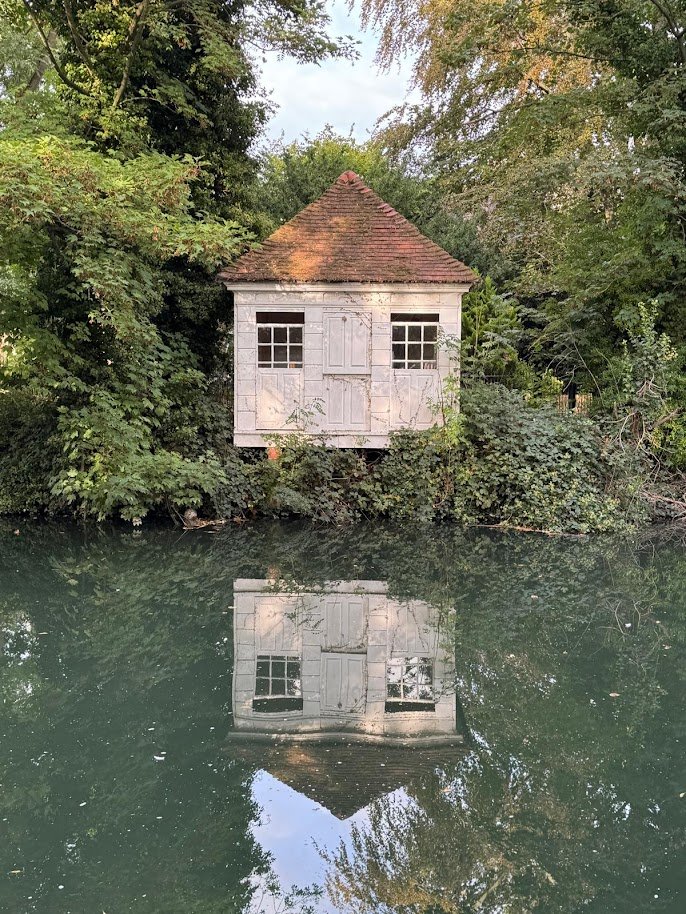
On another warm Saturday at the end of September a large group of 23 Polys gathered at Petts Wood station in south east London. Our numbers included 2 new members and a few members we don’t see very often. The walk took us through Petts Wood which belongs to the National Trust. It was a twisting turning route through the woods and I had to pay attention to the instructions to avoid going wrong. Early on we came to a clearing with a memorial to William Willett, who campaigned for the introduction of Daylight Saving Time. early last century. Later we encountered some of the carved bears on the Chistehurst bear trail. We entered Scadbury Park nature reserve and paused to view the ruins of Scadbury Manor which was home to the Walsingham family in Tudor times. For lunch in Chislehurst we divided ourselves between the Bull’s Head pub (where the beer received much praise) the excellent Walnut cafe and a picnic in the churchyard. The return route to Petts Wood took us through the Hawkswood Estate (also National Trust), then alongside and over a number of railway lines. Some of us rounded off the walk with tea and cake in Petts Wood.
All posts by Gillian
Royal College of Physicians Medicinal Garden Tour 24 September 2026
A group of 13 Poly Ramblers gathered at the meeting place outside the Royal College of Physicians (RCP), eager to begin the tour at 11am. However, the tour guide had not noted the date into his diary and therefore did not show. On making enquiries, we were informed he could get to us by 12:30. One person was not able to stay due to an afternoon commitment. Being near Regents Park and Great Portland Street, a couple of people went to look at the Queen Elizabeth Garden. The rest of the group took the opportunity to grab some food and drink. We were thankful to staff at Honey & Co., who accommodated us and served us in a timely manner.
On returning to the RCP, we were greeted by Dr. Henry Oakeley FRCP, a very knowledgeable tour guide and Garden Fellow of the RCP Medicinal Garden. The initial introduction stated there were many thousands of plant species within the garden. All plants are poisonous. The garden plants are laid out by the continents from which they originate.
‘Plants that evolved poisons survived: of the 400,000 plants on the planet, most are harmful if eaten or touched. A few contain chemicals which are the basis for modern medicines; even fewer are edible. This garden is a living museum to their historical and current uses.’ Dr. Henry Oakeley FRCP, Garden Fellow RCP
The tour began by Dr. Oakeley showing us a leaf from the plant Hepatica nobilis. This leaf has three lobes, like the liver, which also has three lobes. This plant was used to treat liver disorders, until they found it caused jaundice, therefore a liver poison!

There were many interesting tales and stories narrated during the tour, too many for me to remember and to note here. I asked the group to highlight what they took away.
‘All plants being poisonous’.
‘I thought ‘the professor’ was quirky and fascinating he did treat us a bit like naughty school children, but it was fun. It made me realize how little I know about science and Latin and want to learn more about plants.
“I wish it had been longer to learn more about plants. I will look at my garden in a different way! Plants are amazing – and poisonous but this downside also results in cures for many illnesses. But it takes so much research!”
“a seed as poisonous as ricin could be used as a method of killing and also as a necklace for children.”

“I found the story about Taxol very interesting. Also, talking about tobacco and poppy plants. When he started to talk about Datura, it reminded of my first trip to Kew with mum. She was so pleased to see the flower she grew up with.”
“I was fascinated by the number of plants that can be used medicinally but are also toxic. I enjoyed hearing about the Yew Tree as it is my favourite tree!”
“The Madagascan Periwinkle, used as the drug Vincristine within chemotherapy for treating leukaemia has provided much hope for achieving remission of the disease’”
As you can see from the comments there was much to learn and absorb. We all enjoyed the tour and were extremely glad we returned rather than cancelled on this occasion. Dr. Oakeley did send an email to apologise and noted it was all his error; the communication to organise the tour followed.
The garden and RCP museum are open daily, and anyone can call in. Visitors of up to five people can visit Mon -Fri 9am – 5pm. Free entry. There are guided open tours given by fellows of the RCP on the first Wednesday of the month at 2pm (April – October). To book call +44 (0) 20 3075 1649 ask for reception. Tours are free. Voluntary donations are used towards the garden upkeep.
Royal College of Physicians, 11 St. Andrews Place, Regents Park, London NW1 4LE
Further Information www.rcp.ac.uk/about-us/rcp-garden-of-medicinal-plants
Carol D’Souza. Photos by Ida and Carol
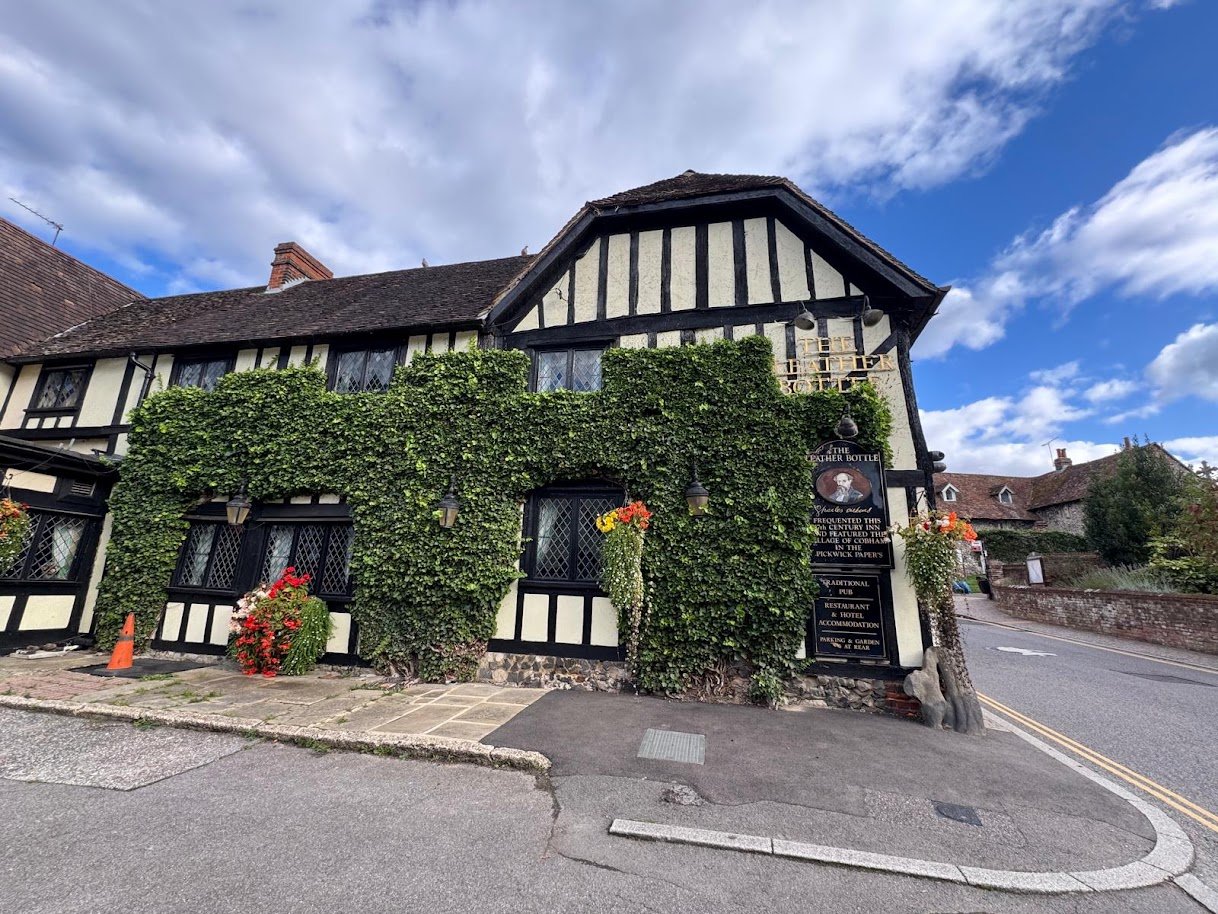
AUGUST BANK HOLIDAY 2026 TRIP TO WORCESTER
This trip came at the tail end of one of the hottest summers on record. When we did the recce in early August everything was brown and parched. What a difference a few weeks makes. On the last Friday in August 48 Poly Ramblers arrived at St Johns Campus at the University of Worcester, thankfully not all on the same train. After settling into our flats (William Morris and Vesta Tilley) and working out the route to and from the campus shop, we set out for an orientation walk, following the River Severn across Sabrina Bridge into Worcester city centre. It was not long before people started to peel off in search of a meal, but those who stuck with the walk saw the Cathedral grounds and the flood wall, the Royal Worcester porcelain museum and the Commandery (Royalist HQ during the Civil War). By the time we reached the medieval Friar Street the rain had started and we dispersed to pubs or back to campus for dinner.
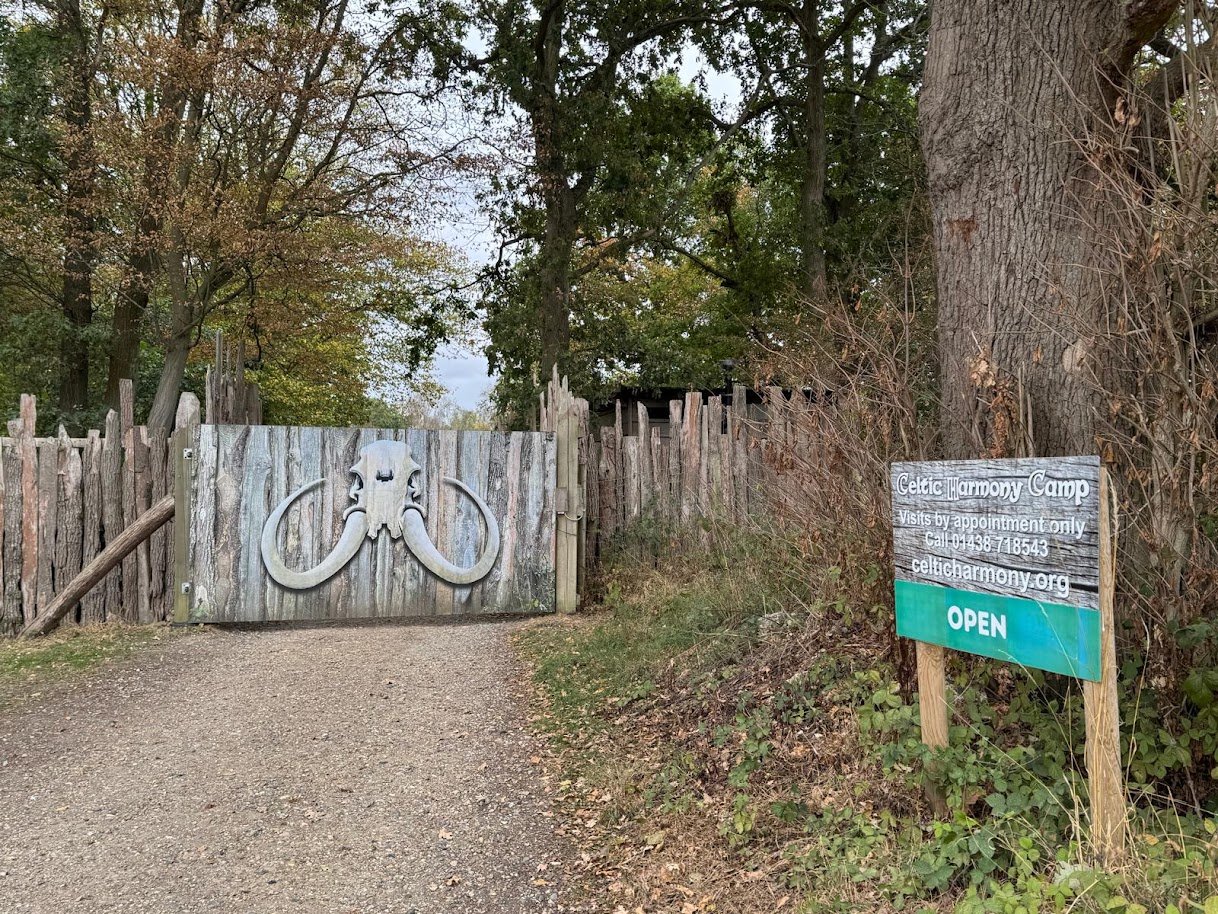
Cookham to Maidenhead – 22 August 2026
A walk from Cookham to Maidenhead, where we ‘had the weather for it’. Cooler and much more tolerable for a longish walk.
16 arrived on the shuttle between Maidenhead and Cookham, Geoffrey (our back marker) and I by car, and Pam joined us at the pub near Bourne End.
The walk is a figure of 9 – a circular walk back to Cookham High St and then linear down to Maidenhead – much researched and recce’d and Chris had his trusty app just in case. Continue reading Cookham to Maidenhead – 22 August 2026
Rye Circular via Winchelsea – 15th August 2026
I had been concerned that following recent high temperatures in London the walking conditions might have been uncomfortable especially as there was no shade. But I needn’t have worried. The temperatures were already on the way down after the latest heatwave and the gentle sea breeze made the conditions just perfect for walking.
12 Poly Ramblers assembled at St Pancras and made the journey down to Rye. After the briefing, we began with a short tour of the main highlights of the town. Rye is a very old town with evidence of existing since Anglo-Saxon times. It is one of five ports (including Winchelsea) or ‘Cinque Ports’ on which were conferred a special status and tax privileges by the Crown in medieval times in return for defending the coastline from invasion. After admiring the old buildings, particularly in Mermaid Street, we made our way out of Rye and along the extensive salt flats that lie between the town and the sea two miles away. It’s hard to imagine that, until a succession of massive storms between the 13th and 16th centuries, both Rye and Winchelsea were on the coast. Continue reading Rye Circular via Winchelsea – 15th August 2026