All posts by Chris Maslen

ISLEWORTH TO KINGSTON (Linear) 8.5 miles on 1st March 2025

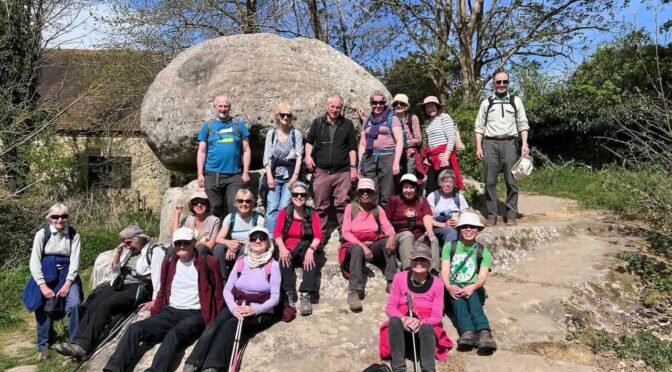
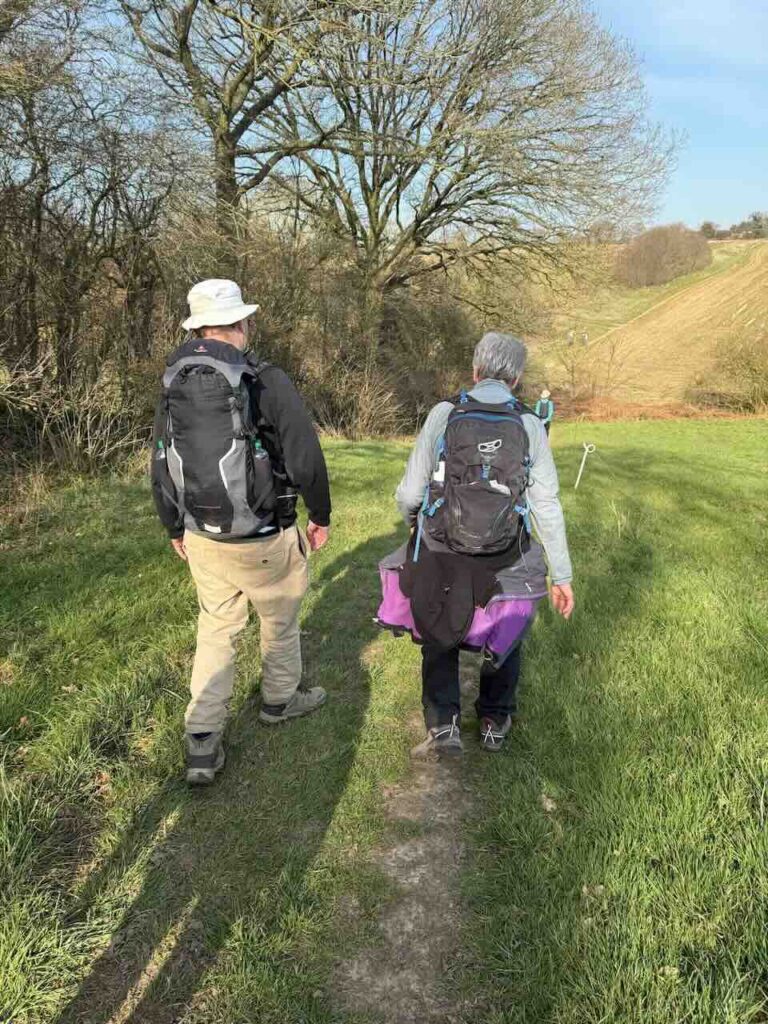
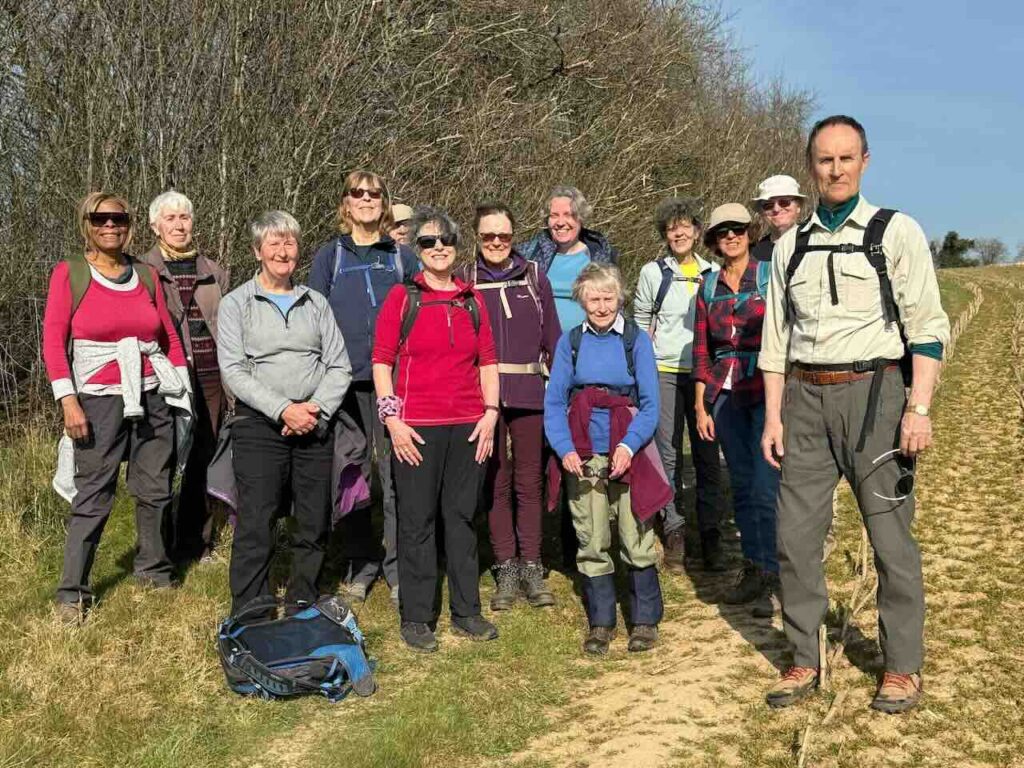
It was a chilly, foggy, start at Isleworth but the sun was soon out to cheer us on our walk.  Isleworth was once a well-cultivated farming and trading settlement, the boundary stretching from the Middlesex bank of the River Thames, westward to the centre of Hounslow and as far as Southhall in 1066. Much of Isleworth became orchards and market gardens in  the 19th Century. Many royal and noble houses were built there including Syon House. 

The leader welcomed 20 polyrambers at Isleworth station where we started our walk to Old Isleworth.  We walked along a street with rows of workmen‘s cottages which were built for workers of the famous Pears soap factory. The Red Lion Pub in the same street has won the local CAMRA pub of the year prize four times since 2003. It was one of only three buildings in Hounslow to be recognised as ‘assets of Community value’.  Then we walked through the Silverhall Park which sits either side of the Duke of Northumberland River.  We entered Mill Plat, one of the oldest paths giving access to the Flour Mill built in 1635. The Ingram’s Almshouses built in 1664 are the oldest almshouses in the Borough.

Apparently there are often up to 20 herons resting in the area during night time. We looked at Warkworth House built in 1866, later becoming West Middlesex hospital accommodation for nurses. Now new houses have been built in the complex. Then the Mill Bridge : over the Duke of Northumberland’s River which was man-made in the 16th century to provide water for the Isleworth Flour Mill. The Tudor mill was made of wood and was destroyed by fire in 1795 and replaced by a brick built structure. It closed in 1934 and was demolished in 1941. Tolson’s Almshouses for the poor is located where the Duke of Northumberland River meets the Thames, and these are now flats. 

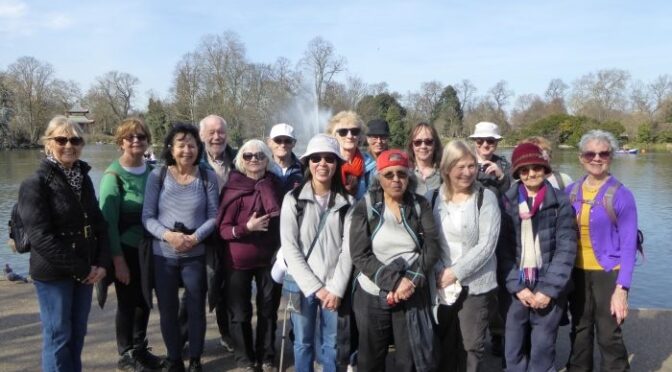
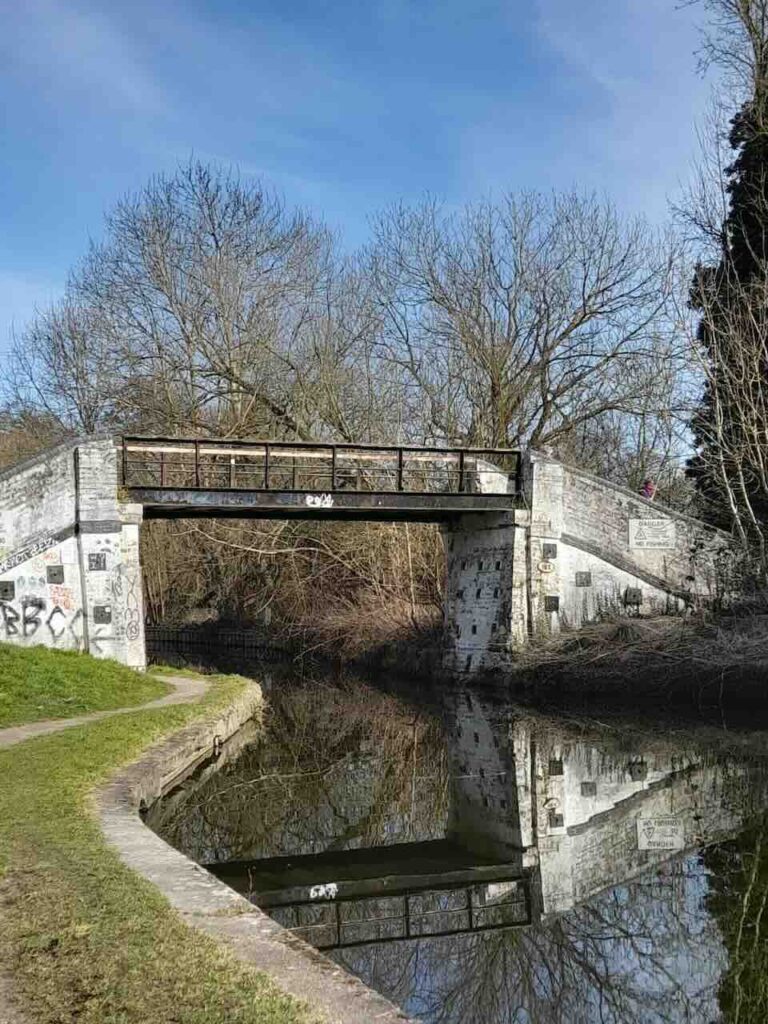
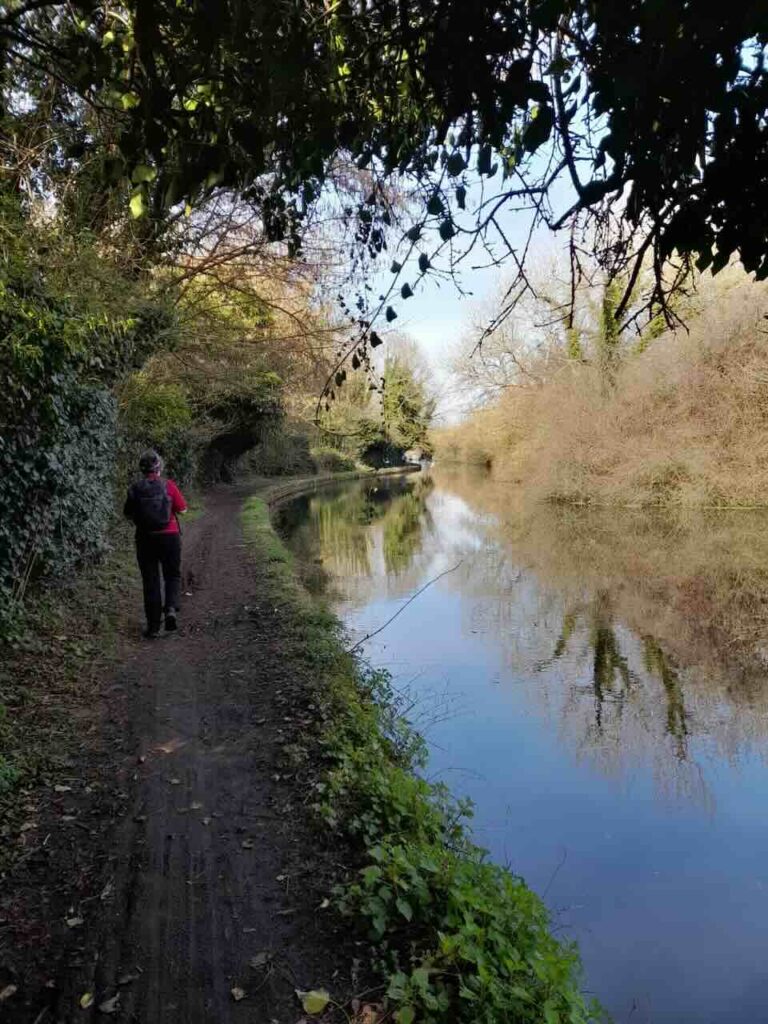
There were many water puddles along the route after lots of rain over the past few days. The group enjoyed lovely views of the Thames. We followed the Capital Ring/Thames Path on the north side of the Thames, crossed Richmond Lock then we were walked through the Old Deer Park. We crossed the busy A316, to the town centre, through two alley ways and passed the house where Virgina Wolf lived for 9 years. We made our way along  the Vineyard Passage, St. Matthias Church ( a victorian gothic style Grade II listed building) to the top of Richmond Hill. Finally, we arrived at our lunch stop in Terrace Gardens where some had their picnic lunch and some lunched at the Hollyhock Cafe. 

After lunch 17 polyramblers continued walking back up to the top of the Hill where we enjoyed fantastic views over the Thames and further afield. It was not long after entering Richmond Park that we reached the Poet’s Corner Pollinator Garden and the John Beer Laburnum Walk. It was a fine clear afternoon and we spent some time at King Henry VIII’s Mound marvelling at the unrestricted view of St. Paul’s Cathedral.

We carried on walking towards Ham gate. I had promised there would be some mud for the group to enjoy, so we took the path to the left side of Ham Common instead of the formal path on the right. After walking for a mile, we arrived at Teddington Lock. One member decided to finish his walk there.  The remaining 16 carried on along the Thames Path towards Kingston and we had a water stop under the 64 year old replacement of Half Mile Tree, a sign marking the official ‘half mile’ to Kingston. 

Overall we had a very rewarding day with glorious sunshine that made the walk very enjoyable. This section of the Thames is thoroughly recommended for anyone seeking a metropolitan ramble with plenty of historical interest.

Ida

Photos by Nita, Les and Ida

FINSBURY PARK to ALEXANDRA PALACE on 22nd December 2024

On a bright cold Sunday morning, seventeen ramblers assembled at Manor House station for a pre-Xmas 5 mile walk through a part of London’s Northern Heights.

We first crossed Finsbury Park, a green Victorian-era haven, created on the remnants of old Hornsey Wood to offer the poor population of North London some breathing and recreation space. Leaving the park by a footbridge over the train tracks out of Kings Cross, we joined the Parkland Walk, created on the route of a disused railway closed to passengers in the 1950s. Declared a local nature reserve in the 1990s, it has become a crucial car-free corridor for both humans and animals. Much artwork adorns the structures en-route including the sculpture of a ghostly goat-man said to haunt the footpath.

Closed tunnels by Highgate station signal the end of this section of the path so we joined the adjacent road up to Highgate Wood to continue our journey. Unfortunately the wood was closed to the public because of the predicted high winds being a threat to safety. We continued on the road to Cranley Gardens where we rejoined the disused track bed for fine views over London and thence our lunch stop at a pub in Muswell Hill.

A few of our number left at this point whilst the remainder climbed up to Alexandra Palace for more fine views. These included many people in fancy dress taking a break from watching the World Darts Championship in the Palace! A downhill stroll then took us to the nearby station for our journey home.

Danny

Photos courtesy of Hilary

Pudding Mill to Beckton on 18th JANUARY 2025

The planned walk on Saturday 18th January was postponed because of the leader’s illness so one planned for February was brought forward. Despite the short notice of the change and a cold grey day, thirteen poly ramblers and guests assembled at Pudding Mill Lane DLR station for a five mile walk through suburban East London. A flight of steps took us up to the Greenway, a most imaginative use of sewage pipes: a level trackway of bonded gravel for walkers and cyclists laid on top of the Northern Outfall Sewage Embankment. The acronym NOSE may have been deliberately chosen by someone with a sense of humour! However there was little nasal evidence of its presence as we strolled along the route of the Capital Ring above the houses and commercial buildings of the borough of Newham, including the ornate pumping house affectionally known as ‘The Cathedral of Sewage’. After about three miles, we left the Greenway and crossed the busy A13 trunk road with distant views of the ‘Beckton Alps’, a giant slag heap of a former gas works, now grassed over and converted into a dry ski slope. We next entered Beckton District Park, a pleasant green space with a lake and numerous water birds. Leaving the park and the Capital Ring, we walked along a tree-lined footpath to the end of the walk at the Fox Connaught pub, a listed old docks building, which provided sustenance for our hungry and thirsty ramblers.

Danny

Photos by Les and Stephen

UPPER LEA VALLEY AND SOMERIES CASTLE on 11th January 2025

Eight Polyramblers gathered outside Luton Airport Parkway station for a 7.5 mile circular walk. It was 11am on a very frosty but sunny January morning  (Earlier,  when I set out from home, my phone showed a temperature of -3C!).  

We all set off across the station car park and approach, negotiating roundabouts onto a B road signposted to Wheathampstead. Then we climbed through a narrow piece of woodland up onto a higher level A road, proceding 100 yds along its footway until we saw a footpath sign to the right leading up some steps into a field on higher ground. The path at the top of the steps followed near the perimeter fence of Luton Airport for about a mile on our left. There was a view of the new Dart shuttle train  and much sound of arriving and departing (mostly EasyJet) aircraft. After traversing a few open fields the path turned half right and away from the airport. Soon we reached a row of cottages beside the ruins of Someries Castle. All that remains of this 15th century manor house is the gatehouse and chapel, it is one of the earliest brick structures in England. We spent a little time exploring the ruins in the bright sunshine.  We then  continued SE along a straight track which soon became a lane taking us into Peter’s Green for lunch.

Most of the party went inside The Bright Star public house, the remainder using seating on the green to eat their own food. Inside the pub was a roaring wood burning stove, and we were served with very welcome vegetable soup. And greeted by a very friendly hound  who took an interest in sniffing my rucksack, as it had sausage rolls inside!!

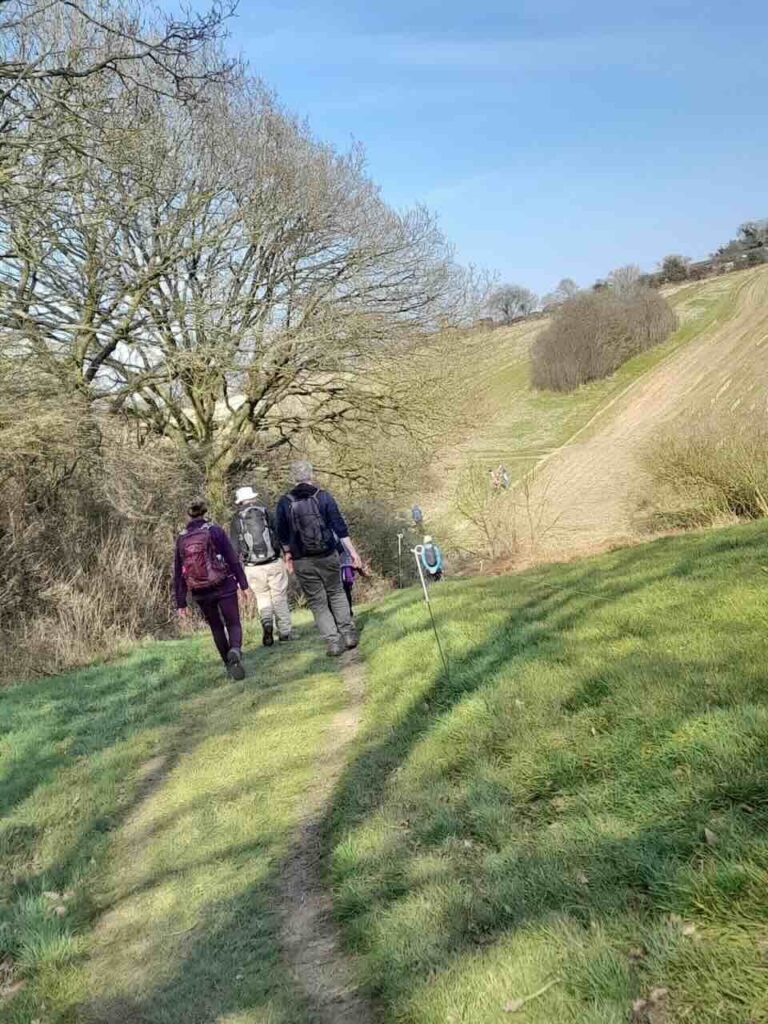
After lunch and a photostop on the green  we took a  path SW across fields, somewhat muddy in places, leading us down into the Upper Lea Valley at East Hyde. Crossing the road along the valley bottom, we took a lane from the other side over the river then a right turn onto a northbound track, being the trackbed of the once Luton,  Dunstable and Welwyn Junction Railway. This soon passed under today’s busy  Midland Main Line, carrying frequent express and Thameslink trains. The track continued along the valley,  beside sewage works on the right, then eventually passed the woods and parkland of Luton Hoo to the left. We came across two metal statues, one of Eric Morecambe, and the other representing Capability Brown who both have associations with the local area. The track soon led us back to the roundabouts and the approach to Luton Airport Parkway station. 

It was now 4 o’clock and getting dusky and colder. Here three polyramblers decided to take a short diversion for refreshment at Costa Coffee before the journey home, the rest headed straight into the station for their train back to London.

Geoffrey

Photos by Gillian, Pam, Chris and Geoffrey